Outside the walls, but inside history
Leaving the walls of Siena and taking Strada dell'Osservanza, you find yourself in a place that few tourists reach. Yet, as soon as you pass through the entrance of the Aurelio Castelli Museum, set up in a wing of the convent adjacent to the Basilica dell'Osservanza, you immediately understand that you have arrived somewhere important. The Basilica dell'Osservanza was built at the behest of San Bernardino da Siena in the early years of the 1400s, and the museum is its natural complement: a path that extends the visit to the church and reveals its hidden heritage, the one that is not seen when passing by the naves.
The loggia, the courtyard, and the unexpected view
Even before entering the halls, you look out onto the 15th-century loggia that opens onto an inner courtyard. And then the gaze glides beyond: Siena appears in the distance, with its roofs, its towers, and the profile that can be recognized even from here, outside the walls. An unexpected, silent viewpoint that offers a perspective on the city different from all the others. You pause for a moment, and then you enter.
What it holds inside
Illuminated manuscripts, reliquaries, and a fresco that changed rooms
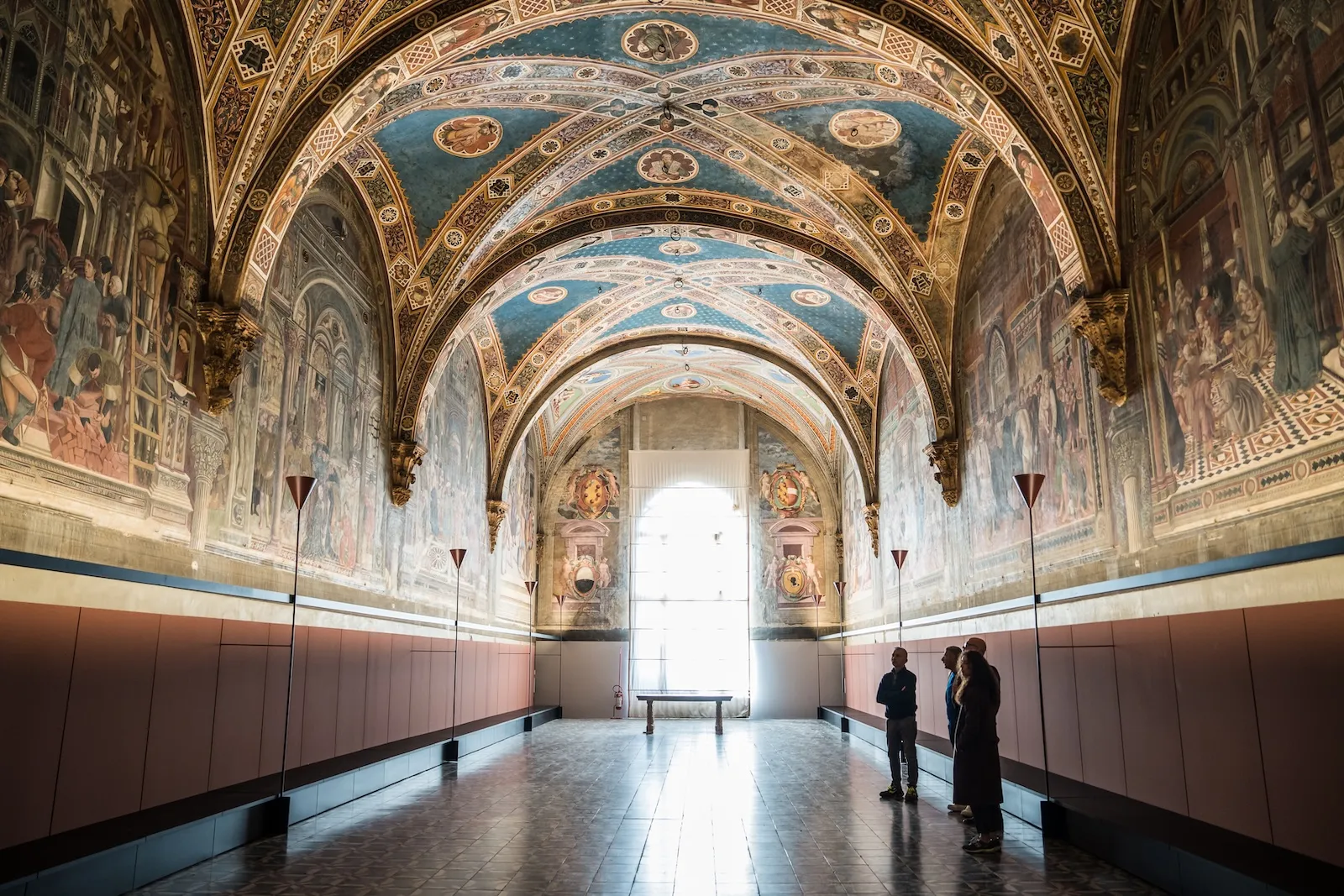
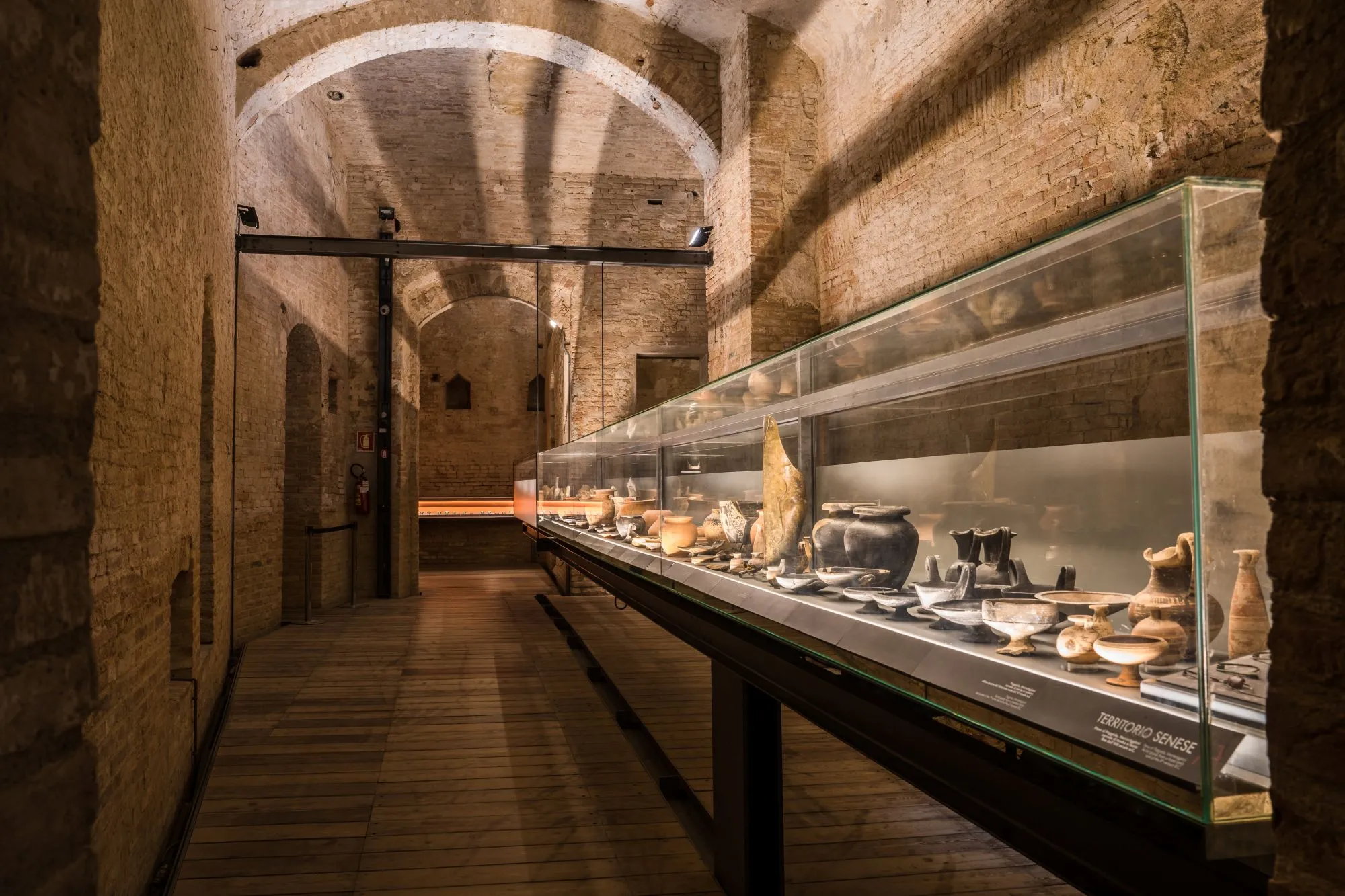
The museum's halls house paintings, sculptures, prints, seals, and illuminated manuscripts created in the convent's scriptorium by Fra Giovanni da Siena and Fra Jacopo Torelli in the 15th century: seventeen volumes that are viewed with the feeling of flipping through something untouchable. On the back wall stands the Last Judgment by Girolamo Benvenuti, a fresco that was originally in the basilica and was later moved here, as if it had sought a more intimate space to continue telling its story. Among the most precious pieces is the reliquary of San Bernardino, made by the goldsmith Francesco d'Antonio in 1462: an object that carries with it the devotion of centuries and is observed while holding one's breath.
The tombstone of Piccolomini and the vestments of the centuries
Among the notable works is the tombstone of Niccolò Piccolomini from 1476, attributed to Antonio Federighi, and the vestments from the 15th-17th centuries, textiles that tell of the care with which the convent attended to every aspect of religious life. Every exhibited object is linked to the history of the Franciscan convent of Siena and, in particular, to the cult of San Bernardino: visiting the museum means taking a journey into that history, step by step.
Aurelio Castelli: The father who saved everything
The museum is named after Father Aurelio Castelli, a Franciscan and scholar who dedicated himself to the recovery and cataloging of the artistic and literary heritage of the Basilica and the Convent dell'Osservanza after the suppression of religious orders. A silent and precious work, without which many of those works would no longer exist. The museum was closed and reopened in 1920, then damaged by the bombings of 1944 and reopened again in the post-war period: a story of resilience that is also read in the exhibited objects, which survived everything.