An Act of Devotion and Community
The history of the Chapel of the Madonna del Rosario begins in 1655, when the contradaioli of the Chiocciola decided to build a place of their own. It was not just a sanctuary: it was a gesture of identity, a concrete sign of belonging. For the first time in Siena, a chapel was built entirely at the expense of a contrada. Artisans, families, young and old contributed as they could: some brought stones, some offered a day of work, some donated a few coins. Thus, a collective work was born, an act of love towards the Madonna and towards their community.
A Unique Baroque in the Heart of Siena
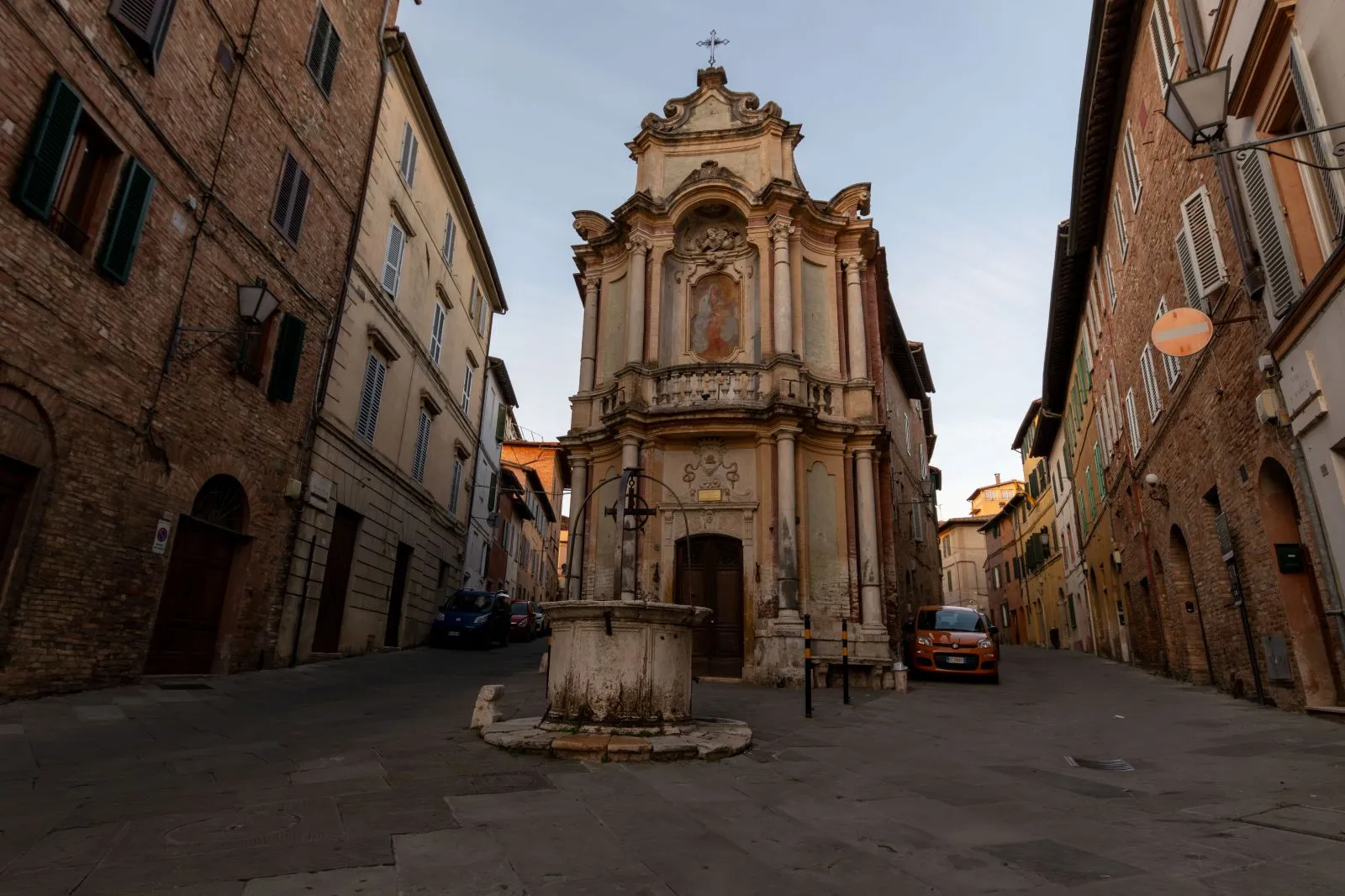
Siena is famous for its severe Gothic, characterized by vertical lines and medieval sobriety. This is why the Chapel of the Madonna del Rosario stands out: it is the only true late Baroque building in the city. The facade, designed by Giacomo Franchini, is a play of curves, scrolls, and frames that seem to move like waves. It is a measured, elegant Sienese Baroque, surprising in such a sober context.
Inside, the chapel housed works created not to impress, but to accompany the life of the community. The altarpiece of the Madonna del Rosario was the heart of the sanctuary: the Madonna with the Child, surrounded by the Mysteries of the Rosary. The original altarpiece is not always visible today, but its presence still lingers in the altar and in the memory of the contradaioli. The walls and the ceiling are adorned with light scrolls, floral motifs, small stucco angels, dynamic frames, and gilding: works created by local craftsmen that create a festive yet intimate atmosphere.
Testimonies of Faith and Tradition
Over the centuries, the chapel has been enriched with small votive paintings, paintings offered for graces received, images of the protective Madonna, and works by local artists from the 17th to the 19th century. They are precious testimonies of popular faith, more important for the contrada than for museums. Once, it also housed a Baroque tabernacle, candlesticks, liturgical objects, and embroidered cloths with the symbol of the Chiocciola.
After the victory of the Palio di Provenzano in 1722, the contrada decided to restore and enlarge the chapel, following a typically Sienese tradition: when a contrada wins, it gives something back to its territory. Thus, the chapel became even more beautiful, richer, and more beloved.
An Identity Place That Continues to Breathe
In 1820, the chapel was deconsecrated, but it has not lost its value. Today, the Chiocciola has reclaimed its use to house the horse on Palio days. Masses are no longer celebrated, but the chapel continues to be an identity place, a meeting point, a fragment of living history. When the contrada gathers, when preparing for the Palio, when celebrating important moments, the chapel comes back to life, telling of devotion, community, and the life that has pulsed within its walls for centuries.