A church that no one notices. And that is worth everything
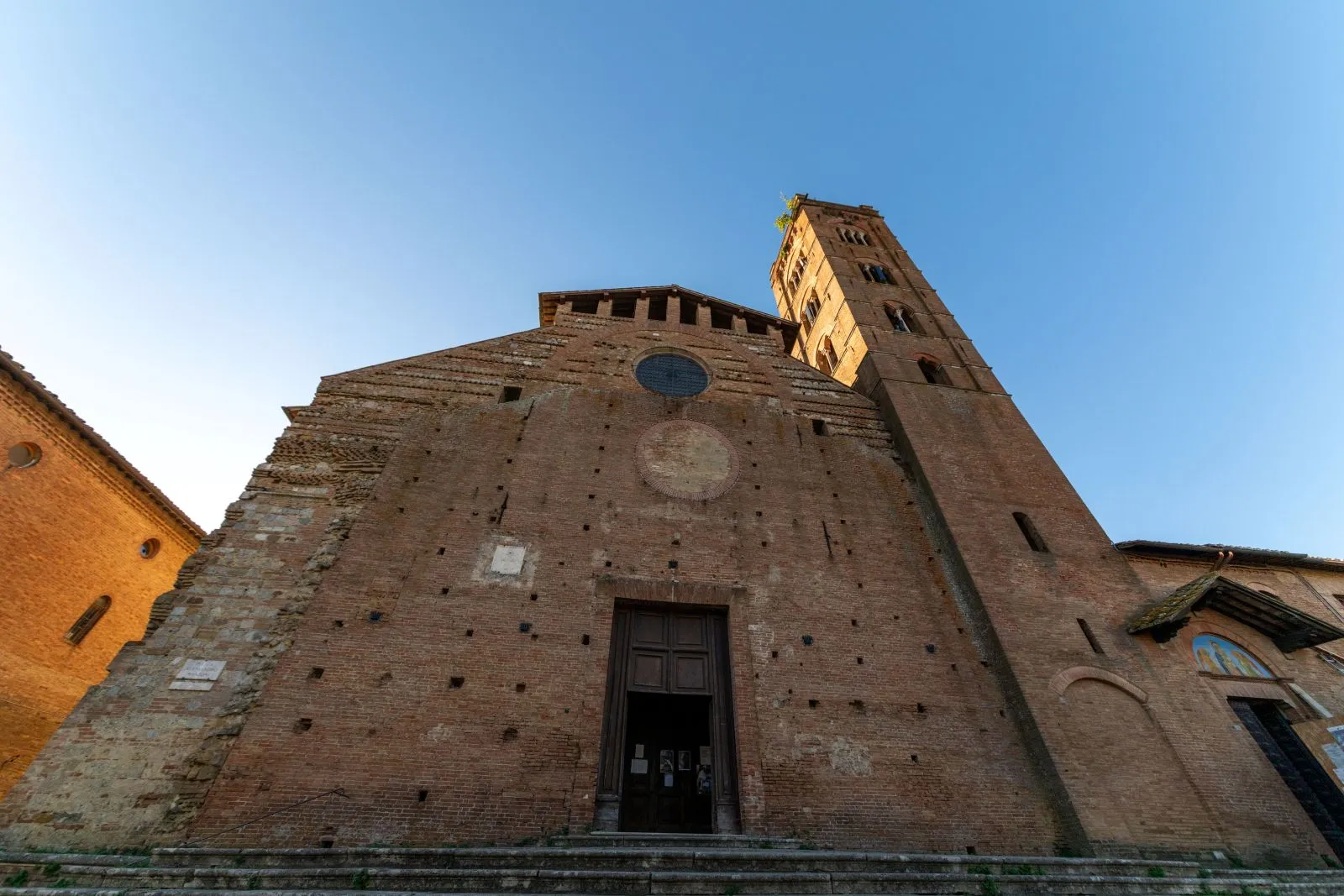
Walking in the heart of Siena, next to the historic headquarters of Monte dei Paschi, one encounters a small and silent square that visitors pass through without stopping. Looking up at the gabled facade of the Church of San Donato, with the lower part in ancient stone and the upper part in brick, the marble rose window captures the light and holds the gaze. Something invites you to enter. And those who enter immediately understand that here there is something that faster tourism has never found: three overlapping eras, medieval, baroque, and twentieth-century, each with its own voice, all in the same space.
From the origins to the Vallombrosan abbey
A spiritual and defensive stronghold
The story begins between 1109 and 1119, when the church was founded as an abbey dependent on San Michele in Passignano, one of the most important centers of the Vallombrosan order. The original name was San Michele al Monte di San Donato: not only a place of prayer but a stronghold that controlled lands, farms, and agricultural activities in the northern part of the city. Its position near the walls and access roads made it strategic from a defensive point of view as well. Even today, standing in front of the facade, one can sense something of that ancient solidity: the stone that does not yield, the walls that remember every century they have endured.
The decline, the Carmelites, and the restoration that changed everything
In the 16th century, the Vallombrosan community quietly disappears, its assets absorbed by other Sienese religious institutions as if they had never existed. In 1682-1683, the Discalced Carmelites arrive: new chapels appear where there was once bare stone, baroque altars replace more sober furnishings, the taste of the 17th century overlays that of the 12th like a new layer of plaster on an ancient fresco. Then, in 1940-1942, a restoration decides that all that baroque must be removed. They want to restore a medieval appearance, according to the fashion of the time. The facade seen today is not the original: it is an interpretation of the past made with the eyes of the twentieth century. A building that has changed its skin three times. And that still bears the marks of each transformation, visible to those who know where to look.
Crossing the threshold
Light, marble, and fragments that endure
The single nave suddenly opens, wide and bright, and the silence that welcomes you is different from that outside: denser, more ancient. The slightly pronounced transept allows the gaze to slide directly to the raised presbytery and the marble high altar. On either side, two Baroque Angels close to the hand of Giuseppe Mazzuoli, one of the greatest Sienese sculptors of the 17th century, have stood immobile for centuries, as if waiting for someone. Approaching the right wall, one finds the fragments: 13th-century frescoes with figures of saints and ornamental motifs typical of Sienese painting of the time. Small, almost shy, but precious like everything that has endured despite everything.
Three eras coexisting without speaking to each other
The 18th-century liturgical furnishings, which survived the restorations of the 20th century, create a contrast that is felt in the air even before it is understood: the baroque that resists next to the reconstructed medieval, the 18th century looking at the 13th from a few meters away, all in silence, all in the same space. The Church of San Donato has not chosen an era to tell. It has kept them all, one on top of the other, as if time had not had the courage to erase anything completely.
The square, Monte dei Paschi, and the contrast that says it all
The church overlooks a small square, still called by the name of the ancient abbey, as if the city had never wanted to forget what was there before. Next to it, the historic headquarters of Monte dei Paschi di Siena looks from the other side: medieval spirituality and modern financial power, separated by a few meters of cobblestone. A contrast that does not surprise in Siena, but that here, in this silent square, is felt with a clarity that cannot be found elsewhere. San Donato is an active church, with cultural functions and initiatives: not a preserved museum, but a living place, waiting for those who truly want to stop.