It is not a museum. It is the political heart of Siena
Crossing the threshold of Palazzo Pubblico, the noise of Piazza del Campo stays outside. You stop, look up, and suddenly the sky appears framed by the bricks of Siena's terracotta, a perfect rectangle of blue that the Torre del Mangia cuts upwards like a blade. It is one of those moments that takes your breath away. Then, as you step back inside, you remember where you are: in the political heart of medieval Siena, built between 1297 and 1308 as the seat of the Government of the Nine. The internal decorations are not just art: they were messages, warnings, models of behavior designed to guide the actions of the magistrates. The Civic Museum was born here because these works were conceived for these spaces, as an integral part of the political message of a city that knew it mattered.
A journey through time, room by room
The Hall of the Risorgimento: Siena is not just the Middle Ages
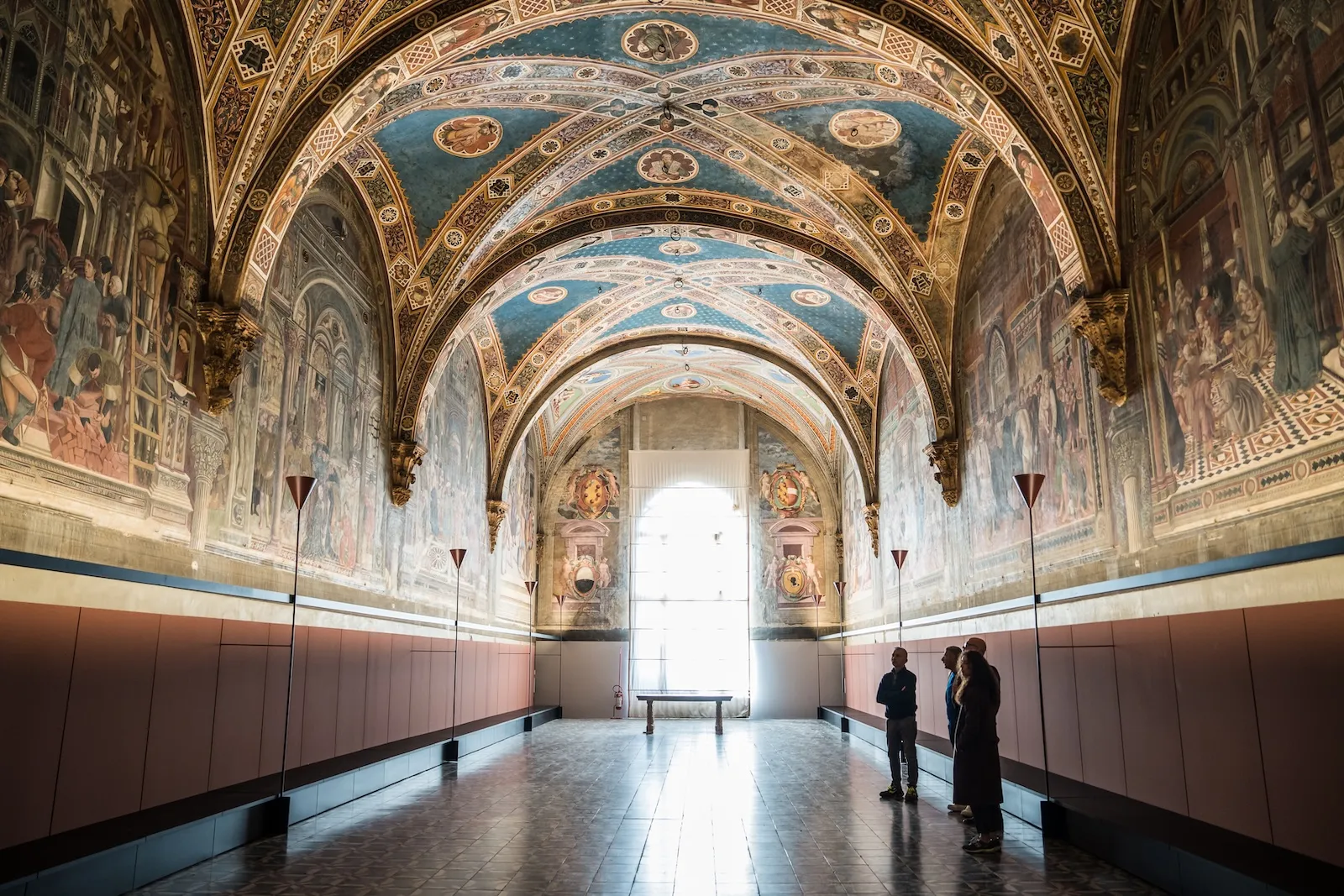
The path opens with a twist. Entering the Hall of the Risorgimento (1887-1890), you stop. The checkered floor stretches towards the back, the walls disappear under the monumental frescoes of Pietro Aldi, Amos Cassioli, and Cesare Maccari, and the golden ceiling closes the space like a mosaic of gold and colors. Everything celebrates Vittorio Emanuele II and the founding episodes of the Unification of Italy, with a grandeur that leaves little room for thought. A powerful reminder: Siena is not just the Middle Ages, but a living piece of national history.
The Hall of Balìa: diplomacy, courage, and freedom
Time contracts in the Hall of Balìa (1407-1408). On the walls, Spinello Aretino paints the cycle dedicated to the life of Pope Alexander III, the Sienese pontiff Rolando Bandinelli. The Battle of Punta San Salvatore, the Peace of Venice, the humiliation of Barbarossa: a story that still lingers in the air, as if the figures were still negotiating.
The Hall of the Concistoro: governing is a moral exercise
In the Hall of the Concistoro, your gaze inevitably rises towards the ceiling. Between 1529 and 1535, Domenico Beccafumi creates the cycle of Public Virtues, a whirlwind of changing colors and suspended figures that warned the magistrates: governing is an exercise in moral balance. The message is clear even today, looking up.
Anticappella and Chapel: faith and politics, face to face
Just beyond, the Anticappella and the Chapel of Palazzo (1406-1414) house the frescoes of Taddeo di Bartolo, including the Maestà and the cycle of the Patron Saints of Siena. The carved benches by Domenico di Niccolò dei Cori transform the space into a place where faith and politics intertwined before crucial decisions. You enter and immediately understand that here they did not pray only out of devotion.
The Hall of the World Map: the heart of the city
The Hall of the World Map suddenly opens up and takes your breath away. It was the political heart of the city, the place where the General Council met under the watchful eyes of the masters of the Sienese school, as if art were watching over the decisions. Two works have faced each other in silence for centuries. On one side, the Maestà by Simone Martini (1315-1321): a regal Madonna under a silk canopy, with details so precious that they still seem to vibrate with light. On the other, the famous Guidoriccio da Fogliano at the Siege of Montemassi (1328), also by Simone Martini: a solitary knight crossing an abstract and symbolic landscape, frozen in time, an eternal icon of Sienese identity. You stop in the middle of the hall and realize that here you are not just looking at paintings. You are looking at Siena.
The Hall of the Nine: the cycle of Good Government and Bad Government, the most beautiful political manifesto of the Middle Ages
The Hall of the Nine is the last stop before understanding everything. Between 1338 and 1339, Ambrogio Lorenzetti paints on the walls something that is not just a fresco: it is a question. The allegory of Good Government and Bad Government. On one side, the city and countryside in harmony: maidens dancing, industrious merchants, fertile fields under the protection of Securitas. On the other, the demonic tyranny that generates violence and ruin. Two opposing worlds, separated by just a few meters of plaster. The message is simple, almost brutal: the beauty of a city depends on the justice of those who lead it. You enter curious. You exit with something you can't shake off.
Before leaving, one last look
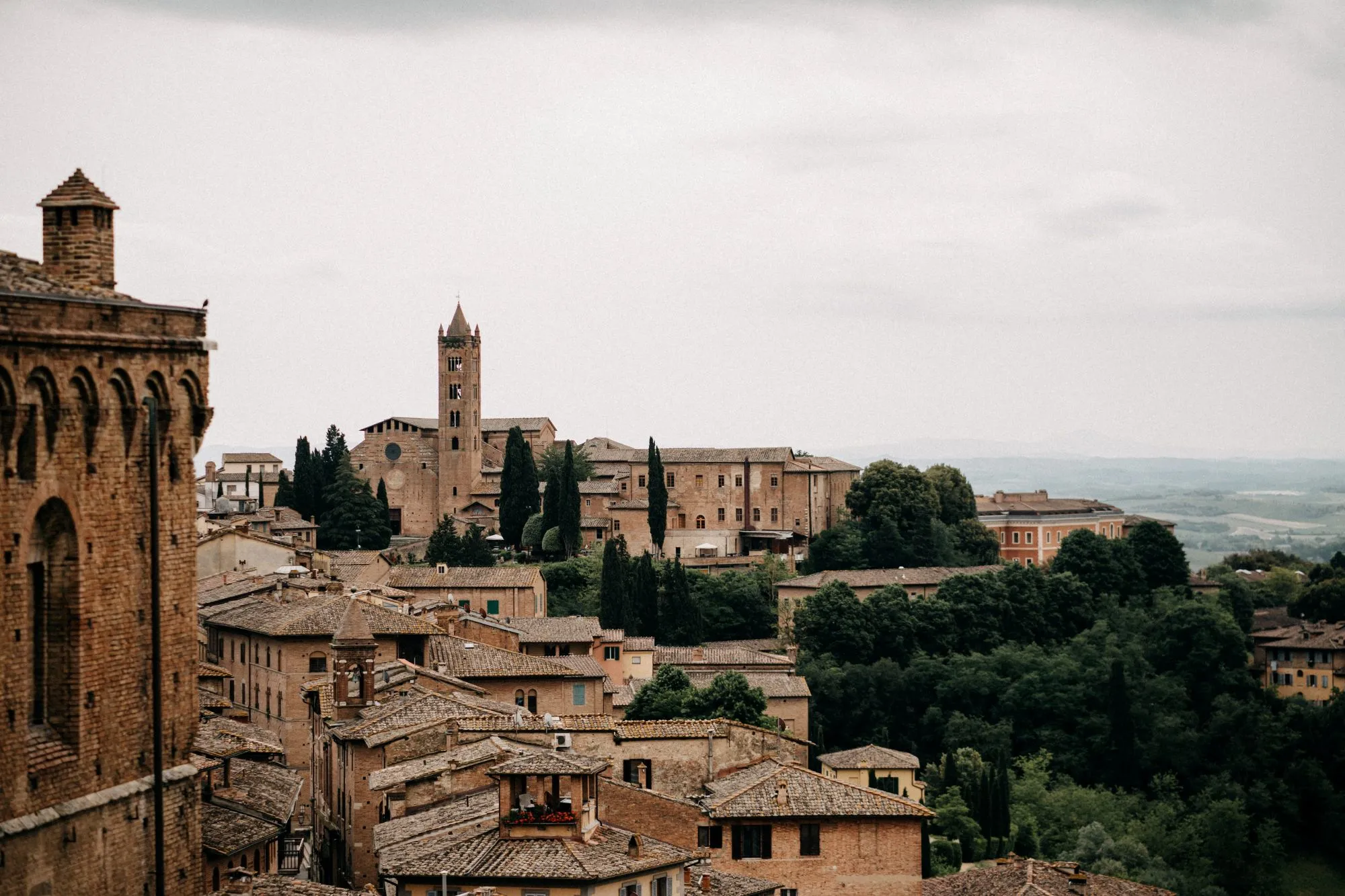
The last step is towards the light. The Loggia dei Nove (1348) opens onto the southern hills of Siena, a viewpoint that takes away words. After halls, frescoes, and centuries of history, the landscape outside reminds you that everything you have seen inside was not art for art's sake: it was the attempt of a city to be better. A breath, and you return to the world.