 info@contradadellaquila.com
 0577 288086
GENERAL INFORMATION
HEADQUARTERS: Casato di Sotto, 86 - Terzo di Città
SOCIETY: "il Rostro" - Vicolo del Verchione, 6
NAME OF THE CONTRADA MEMBERS: Aquilini
MOTTO: "Unguibus et Rostris - Of the Eagle the beak, the claw and the wing"
COAT OF ARMS: golden shield with the black bicephalous Eagle crowned in ancient style and holding in the right claw the scepter and the sword and, in the left, the imperial globe central and crossed. Charged on the chest is a flaming golden shield with the letters U.I (Umberto 1°) in uppercase Roman characters of blue.
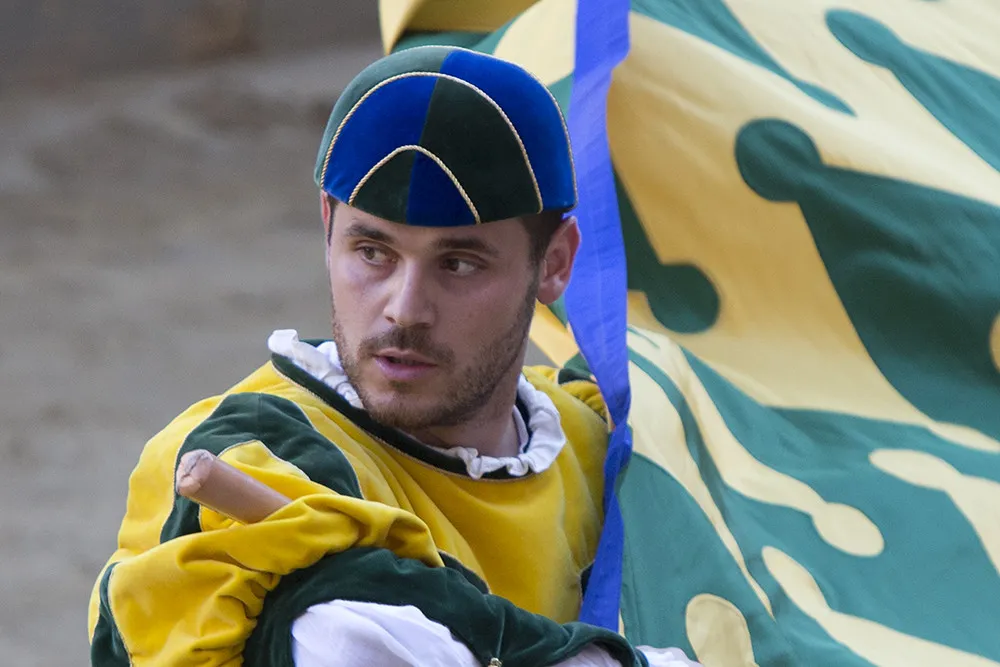
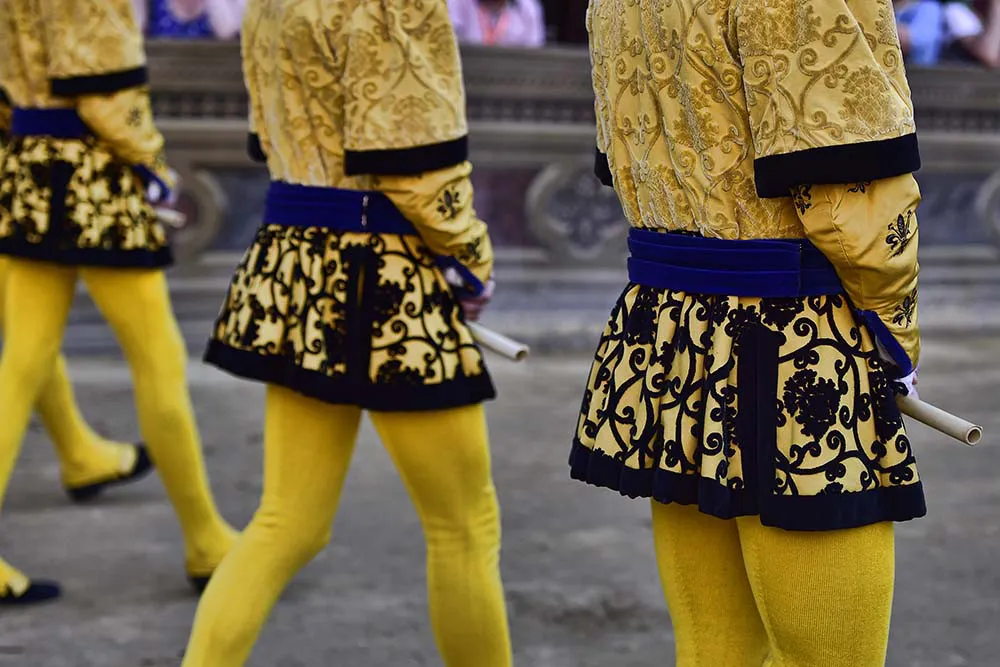
COLORS: gold yellow, with black and blue inserts, with the imperial Eagle in the center
SYMBOLIZES: combativeness
PLACES AND REFERENCES
CHURCH AND ORATORY: Oratory of San Giovanni Battista known as "dei Tredicini", Casato di Sotto
PATRON AND TITLE FESTIVAL: SS. Name of Mary - September 12
MUSEUM: ground floor of the 16th-century Palazzo Agazzari-Nastasi, at the corner between Casato di Sotto and Costa Larga
FONTANINA: work by the sculptor Bruno Buracchini (1963), on the base the motto "Unguis et Rostris". It's located in Piazza Postierla.
RELATIONS AND ORGANIZATION
RELATIONS WITH OTHER CONTRADE:
allies Civetta and Drago
enemies Pantera
CORPORATIONS: notaries
MILITARY COMPANIES: San Pietro in Castelvecchio, Casato di Sopra, Aldobrandino del Mancino.
HISTORY OF THE DISTRICT OF THE EAGLE
The origins of the District of the Eagle date back to the Middle Ages, linked to the presence of the Marescotti family, whose heraldic coat of arms, adopted by the district, depicted an eagle.
From the earliest times, the district participated in the oldest forms of games and competitions between districts, which over the centuries evolved into the current Palio di Siena. Over time, the coat of arms underwent several changes. For about a century, from 1622 to 1718, the district did not participate in public games, effectively disappearing from the scene as it was absorbed by neighboring districts. It was thanks to the knight Giovanni Antonio Pecci that in 1718 it came back to life, after asking the tribunal of Biccherna to be allowed to participate again in the Palio.
Between the 18th century and the present day, various alliances have been formed and dissolved. As for reference places, initially the palii and gatherings were held in the church of San Pietro in Castelvecchio, later moving to the church of the Hospital of Santa Maria della Scala. Since 1788, the district has been based in the Oratory of the Tredicini.
PALII AND RESULTS
WON PALII: 30 for the Contrada | 25 for the Municipality
PARTICULARITIES
TITLE: The Contreada of the Eagle has the title of "Noble" for the welcome given to Charles V of Habsburg (Emperor of the Holy Roman Empire) during his visit to Siena on April 24, 1536. It was granted the right to fly the two-headed Eagle symbol of the Empire and the title of "Noble". Previously, the District had a flag with the one-headed Eagle.
TWINNINGS: L'Aquila and Valletta (Malta)