A gesture of love towards the Virgin
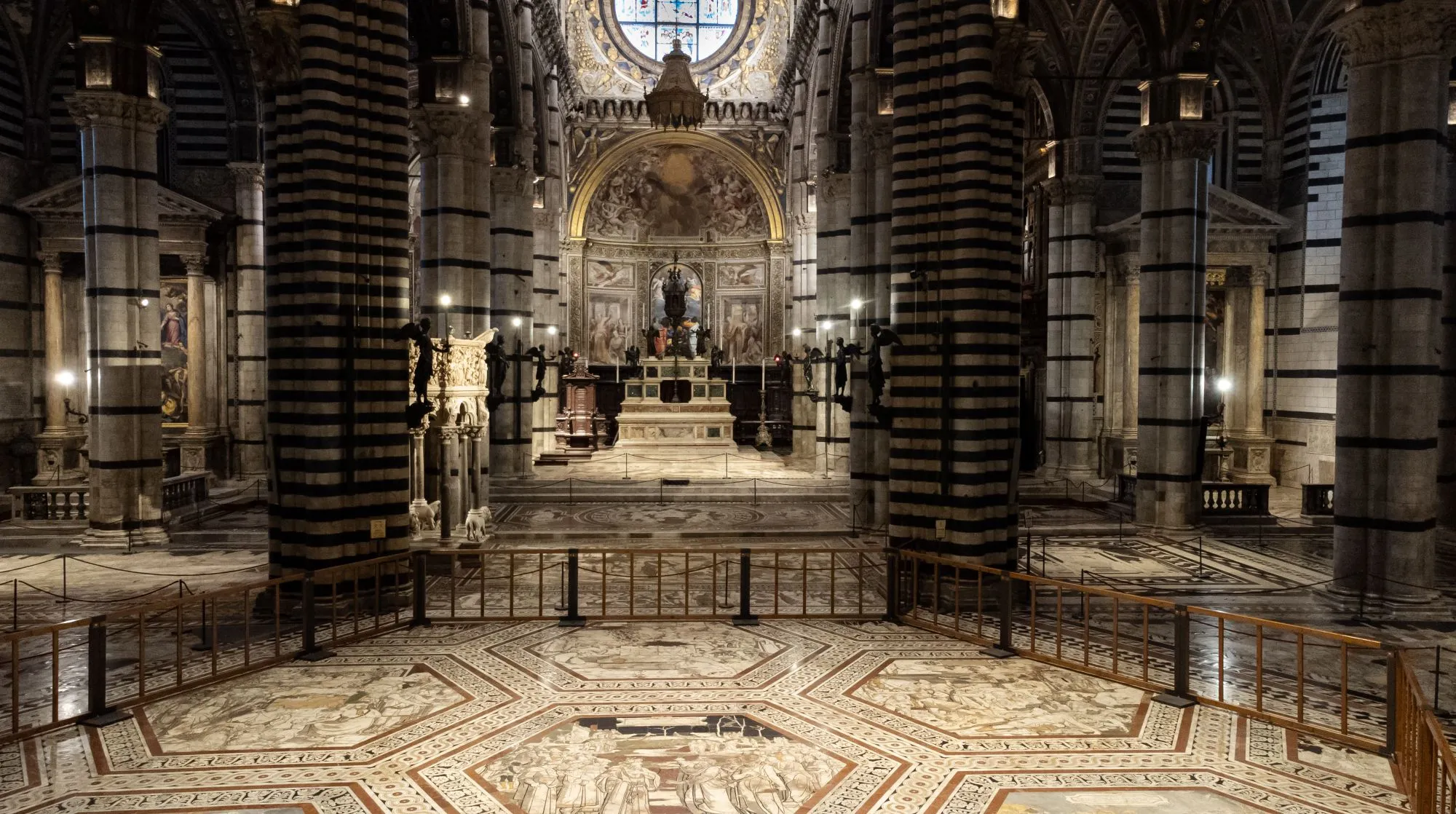
There is a moment, upon entering the Siena Cathedral, when you turn right and the black and white of the medieval floor gives way to something completely different: gold, polychrome marbles, lapis lazuli, gilded bronzes. It is the Chapel of the Vow, and the contrast is intentional, necessary, almost moving. As if that chapel wanted to say: here we stop, here we enter another state of mind.
Commissioned by Pope Alexander VII, belonging to the Chigi family, and built in 1660, the chapel has a circular plan covered by a golden dome that seems to gather all the light from the sky and pour it onto the altar. It is one of the most important examples of Baroque art and architecture present in Siena: a world of stuccoes, preciousness, and beauty that cannot be contained.
Bernini and his students
The statues that seem to breathe
Inside that richly adorned chapel, two figures stand out above all: Saint Jerome and Saint Mary Magdalene, both works by Gian Lorenzo Bernini, the absolute genius of Italian Baroque. They are not statues: they are presences. The drapery that moves, the tensed muscles, the gazes filled with an intensity that marble should not be able to contain.
Next to them, Saint Catherine of Siena and Saint Bernardino of Siena, works by Bernini's students: a constellation of Sienese holiness gathered in a space that seems made just to hold it.
Carlo Maratta and the paintings
On the side walls, two paintings by Carlo Maratta, a painter of the late Seicento, stand out: the Visitation and the Flight into Egypt. Soft colors, intimate atmospheres, a narrative grace that balances the power of the sculptures and creates a silent dialogue between painting and marble.
The Madonna of the Vow. The Advocate of the Sienese
At the center of it all, at the center of the chapel and at the center of Sienese devotion for over seven centuries, there is her: the Madonna of the Vow, painted by Dietisalvi di Speme around 1267-1270, tempera and gold on panel. An image that still carries the sacredness of that era, looking at the faithful with that ancient sweetness that no restoration has ever been able to, nor ever will, change.
It is the most important Marian image of the city, and bears the title of Advocata Senensium — the Advocate of the Sienese: she who intercedes, who defends, who protects. It was previously called Madonna delle Grazie; the current name spread after the plague of the Seicento, when the Sienese turned to her in their darkest moments.
Seven centuries of prayers
The devotion of the Sienese towards this image has never been merely devotional: it has been concrete, historical, documented. During the plague of 1348, during World War II — when in 1944 the keys of the city were symbolically offered to her, still preserved today as a testimony — during the Covid-19 emergency in 2020 and for peace in Ukraine in 2022: every time Siena has been afraid, it has looked towards this chapel.
And here an important clarification: popular tradition often links the Madonna of the Vow to the Battle of Montaperti in 1260, but the vow pronounced by the people before that battle was made before the Madonna degli Occhi Grossi, kept in the Museum of the Opera del Duomo. The Madonna of the Vow was instead commissioned after the victory, as an act of thanksgiving: not a prayer before the battle, but a promise kept afterwards.
Come meet her
Enter the Cathedral, turn right, stop in front of the altar. Look the Madonna of the Vow in the eyes and think of all those who have looked at her before you, for seven centuries, bringing her fears, hopes, thanks.
Some places are not visited: they are frequented, just as one frequents someone they trust.
Siena Cathedral, right nave under the dome, Piazza del Duomo.