The frescoes of the 13th century: when art rewrites history
A discovery that changed the history of Sienese painting
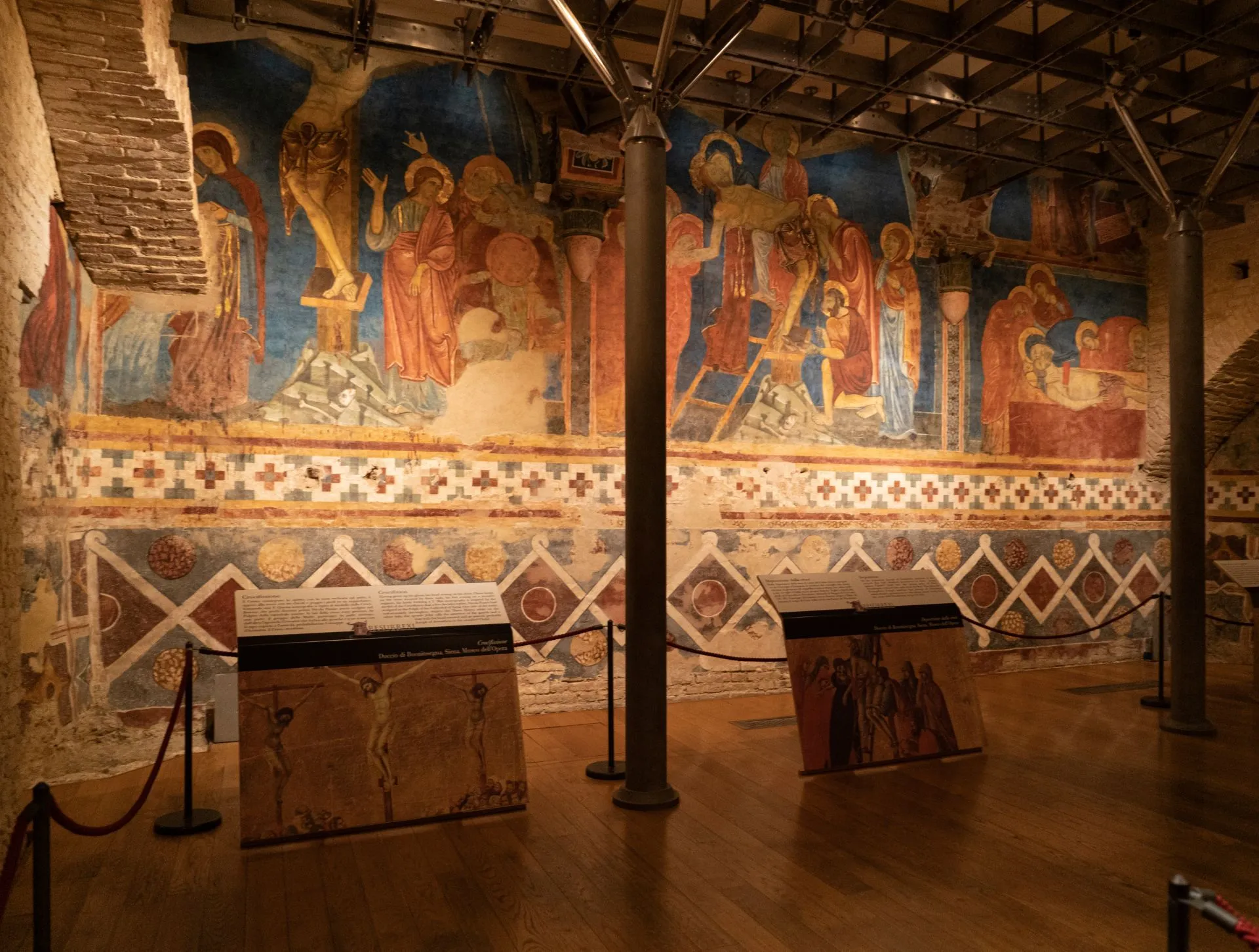
The Crypt of the Cathedral is not just an extraordinary space, it is a historiographical revolution. The frescoes, dating back to the late 13th century, forced art historians to completely rethink the evolution of Sienese medieval painting, anticipating figurative solutions that were thought to have appeared only with Duccio di Buoninsegna and his followers. What seemed to be an invention of the 14th century was already here, hidden beneath the feet of those who had walked unknowingly over this treasure for centuries.
The daily life of medieval Siena painted on the walls
The frescoes of the crypt do not only tell sacred episodes. They tell the Sienese of the 13th century: the architecture of their houses, the clothing of the time, the familiar and everyday gestures that no written document could ever convey with this immediacy. Walking among these walls means peeking through the keyhole into the life of a city lived eight hundred years ago and discovering that, after all, it was not so different from ours.
The atmosphere of the Crypt: a place out of time
No windows, no distractions: only the 13th century
The Crypt has no windows. The artificial light is precisely calibrated not to damage the frescoes, creating a collected and intimate atmosphere that powerfully enhances the feeling of being elsewhere, or rather, of being back. Back seven centuries. Many visitors describe entering the crypt as a moment of suspension: every noise disappears, time slows down, and what remains is only the silent presence of those painted figures watching you from the walls as if time had never passed.
Layered Siena: a city that grows upon itself
The Crypt is one of the most eloquent examples that shows us the layered nature of Siena: a city that does not destroy its past, it hides it, incorporates it, and in doing so, preserves it. What had become over time first a secondary entrance and then even a dump of materials has revealed itself to be one of the most precious spaces of the entire Sienese artistic heritage. History, in Siena, often hides beneath our feet.
Why the Crypt is a must-see stop in the Siena Cathedral
A place that history books were still searching for
Visiting the Crypt of the Siena Cathedral, not to be confused with the crypt of the Santa Maria della Scala museum complex, means entering a place that until a few decades ago did not exist on maps, in catalogs, or in collective memory. A place that the city had lost and that chance has returned to the world. It is not just medieval art: it is a story of loss and rediscovery, of oblivion and resurrection, that makes this visit truly unique and original.