A gift of stone and prestige
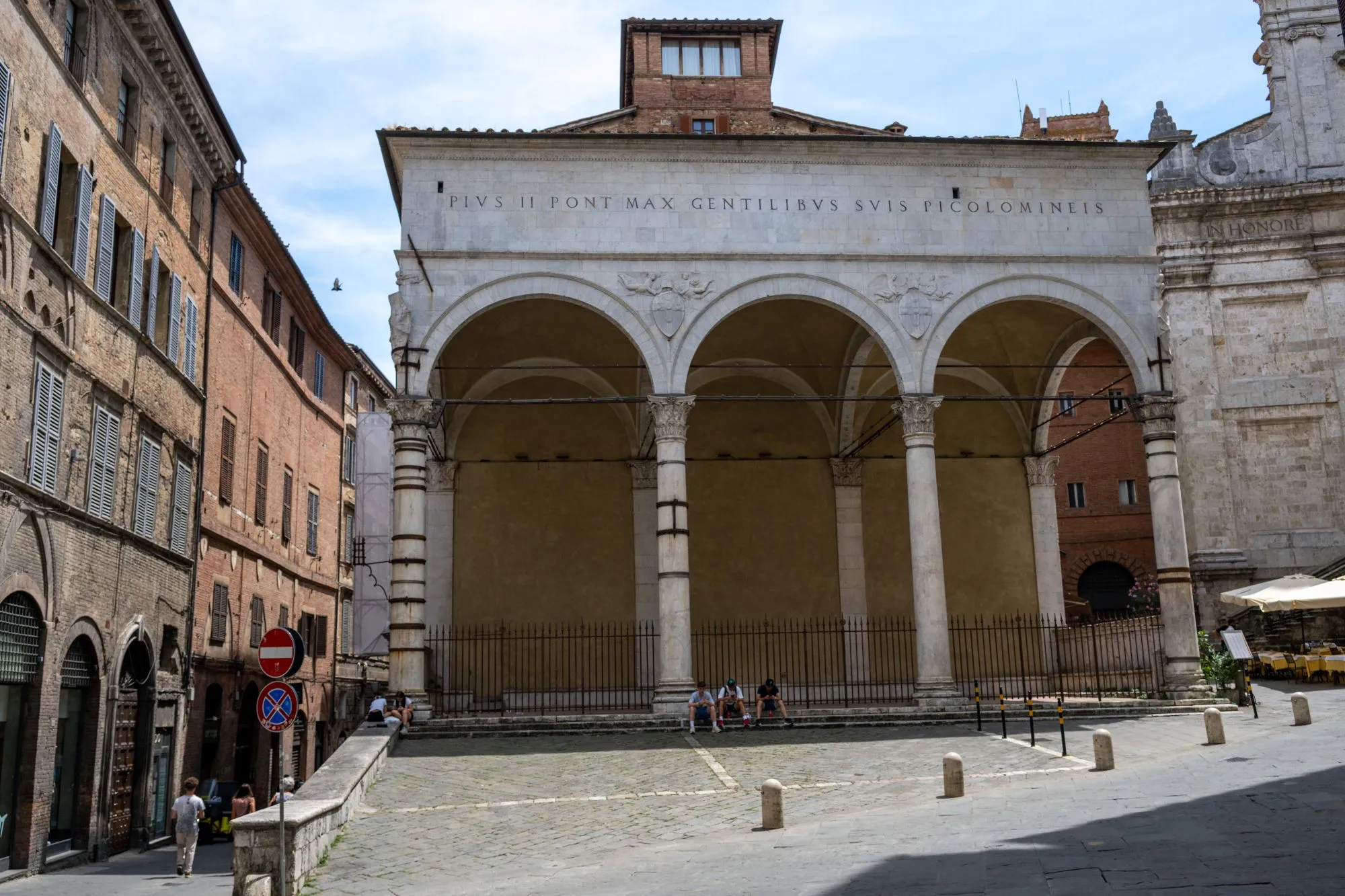
In 1462, in the heart of a Siena still profoundly Gothic and medieval, something unexpected appeared: three arches of white travertine marble, bright, proportionate, the offspring of another idea of beauty. The Pope's Loggias were not born out of defensive necessity, nor for practical utility. They were born out of willingness and prestige: that of Pope Pius II Piccolomini, an illustrious Sienese, one of the greatest humanists of the fifteenth century, who wanted to leave his city, and his family, an indelible mark of elegance and power.
The project was entrusted to Antonio Federighi, one of the leading artists of the Sienese Renaissance, who transformed a space occupied by buildings and workshops into one of the most refined places in the city. An urban and symbolic operation at once: first, the pre-existing constructions were demolished, then in their place arose something that seemed to come from another world.
The architecture, a Renaissance manifesto
The loggias are a manifesto of style: three full arches, columns with Corinthian capitals, proportions inspired by ancient architecture, all made of white travertine. In a city predominantly made of red bricks, that white stands out with an almost provocative strength, like a declaration of belonging to a different, more classical, more Roman taste.
On the corners and facades, the coats of arms of the Piccolomini with the five crescent moons stand out. At the top, the inscription in Latin leaves no doubt: "PIUS II PONT MAX GENTILIBUS SUIS PICCOLOMINEIS", Pius II, Supreme Pontiff, to his Piccolomini relatives. A gift, certainly. But also a signature, proud and permanent.
A story of promises and silences
The loggias were designed for festivities, receptions, weddings, public celebrations, and solemn funerals. A worthy frame for the most important events of city life. In reality, however, they were never much used for these purposes. Only in the Eighteenth Century did they come back to life, serving as a stage for public meetings and the discussions of graduation theses of students from the Studium Senese: a sober, almost domestic use, far from the grandeur imagined.
Today the loggias are closed by a gate, opened only on the occasion of special events. A silent presence, but no less powerful for that.
Come and discover them
The Pope's Loggias are one of those corners of Siena that are found almost by chance and are hard to forget. That white that stands out against the red of the bricks, those perfect proportions, that papal signature engraved in stone.
Via di Città, near the Church of San Martino, Siena.