Looking for it, you find it almost by chance
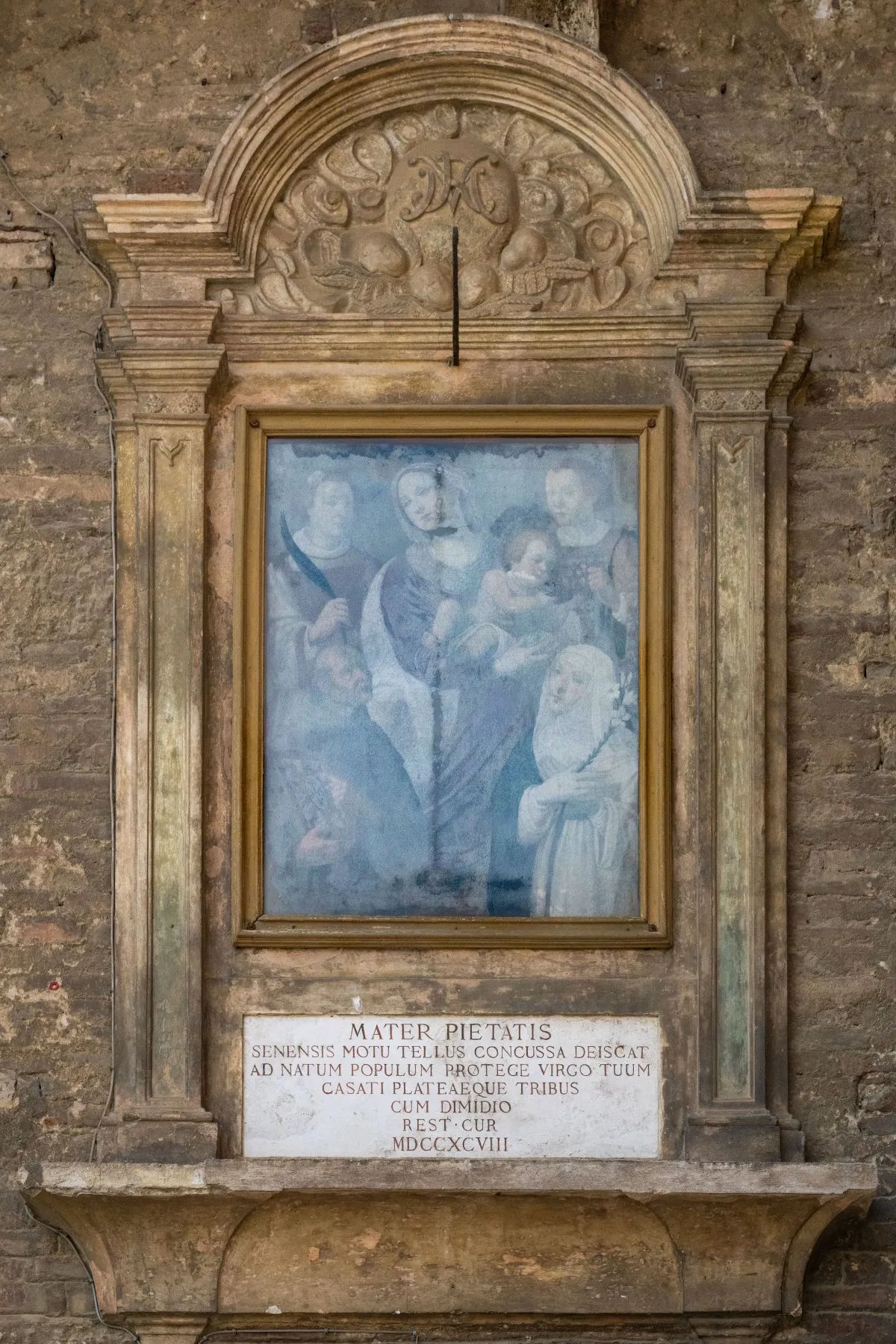
Walking in Piazza del Campo, at the corner between Bocca del Casato and Chiasso del Bargello, there is something that catches the eye before the mind registers it. A tabernacle, a travertine frame, a canvas depicting the Madonna with Child surrounded by saints. The Madonna dei Terremoti does not announce itself. It is found by looking up at the right moment, and those who find it immediately understand that behind that frame lies a story worth listening to.
The origins: a lost fresco and a legacy that endures
Gentile da Fabriano and the lost work
Originally, the tabernacle housed a fresco created around 1424 by Gentile da Fabriano, depicting the Madonna with Child along with Saint John the Baptist, Saint Peter, Saint Paul, and Saint Christopher. A precious work, capable of capturing the gaze and spirit of the faithful, which unfortunately no longer exists today, lost in the folds of time like many other traces of Sienese history. In 1764, the ancient niche was replaced by a canvas from the early seventeenth century, probably created in the workshop of Francesco Rustici, known as Rustichino, embellished with stuccos and decorations by Bernardino Cremoni. The new canvas depicts the Madonna with Child, accompanied by Saint Bernardino, Saint Catherine, Saint Lawrence, and Saint Stephen, continuing to tell, with silent grace, the devotion of a community that traversed the centuries carrying with it faith, fears, and gratitude.
The earthquake that changed everything
The night of May 26, 1798
On the night of May 26, 1798, a violent earthquake struck Siena. The popular areas suffered the greatest damage, and the tabernacle of the Bocca del Casato was also damaged: the stucco frame destroyed, the canvas compromised. Yet, amidst the astonishment and relief for the spared neighborhoods, the citizens saw a sign: the protection of the Virgin. It was then that they decided to return their gratitude to the Madonna with a gesture that would last through the centuries: they restored the tabernacle.
The travertine frame and the memory carved
The canvas was placed in a new travertine frame, sober and solemn, with a plaque in Latin that commemorated the event and the gratitude of the neighborhood. From that moment, the tabernacle took the name of Madonna dei Terremoti: a name chosen not by artists or nobles, but by those who had lived through fear and wanted to forever fix the mark of divine protection. Walking today in Piazza del Campo and looking up at the frame, one can still read that gratitude, silent, carved in stone and in the heart of the city.