A stone worth more than a tower
There is something different about Palazzo Tolomei compared to all the other medieval palaces in Siena. It is not just the beauty, it is not just the antiquity. It is the message written in the stones: power no longer needs towering heights to assert itself. It needs elegance, solidity, a palace that tells anyone who looks at it — I am here, and I remain.
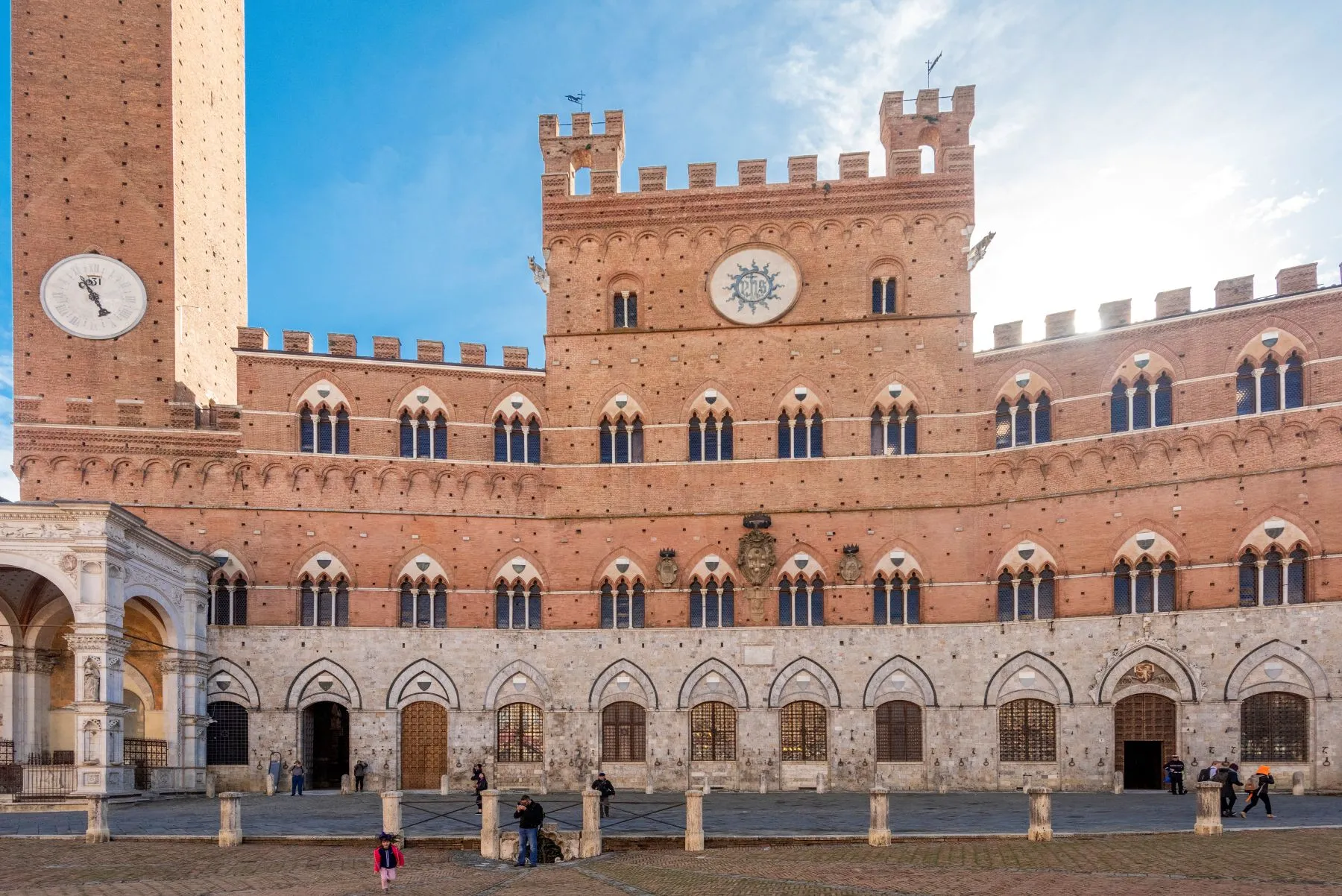
Built between 1207 and 1212 by the brothers Jacopo and Tolomeo di Rinaldo Tolomei, the palace is a manifesto of the purest Sienese style: double windows adorned with carved rosettes, small arches embroidered with stone lace, sculpted frames on the sills, lion-headed busts flanking the portal with family crests watching from above. An austere and refined beauty, which does not shout but imposes itself.
A stronghold in the heart of the city
Yet, behind that grace, something harder was hidden. Despite being located in the heart of the city, the palace was almost a stronghold: locked at night with stone doors, the alley of the Torre secured by gates at both ends, the alley of the Coltellinaio reduced to a dark passage overshadowed by the grand halls of the noble floor. The Tolomei family did not just live in a palace: they lived in a fortress disguised as a residence, where every architectural detail was also a defense system.
The three-nave warehouses supported by square pillars, the medieval roof on the facade to protect customers from dripping: everything speaks of a place that was both home, banking headquarters, and symbol of power.
A story of fires, vendettas, and battles
The fire of the people and the fallen towers
In 1240, the palace suffered damage from a fire set by the people, in one of the many flare-ups of political conflict that swept through medieval Siena. In 1268, during clashes with the Salimbeni, the towers were brought down: a huge loss, but also a sign of the times. Power was changing form.
The most dramatic ruin came in 1267: accused of "Guelphism" for attempting to negotiate with the Papacy for the revocation of the excommunication of 1262 by Urban IV — an excommunication that freed debtors from the obligation to pay, which for a family of bankers meant total ruin — the Tolomei had to flee and the palace was destroyed. Only the window columns were saved, too precious for the popular fury to afford to bring them down.
The seat of the General Council
Until 1284, the palace housed the General Council of the Republic of Siena: it was within these walls that the fate of the city was decided, alliances were discussed, and battles were planned. Here, or in the previous seats of the Tolomei at the Church of San Cristoforo, decisions were made that led to the War of Montaperti.
Pia, Dante, and the legendary origins
Tradition has it that Pia dei Tolomei, mentioned by Dante in the Purgatorio with the sweetest and most melancholic verses of the Comedy, may have lived right here. A literary echo that transforms the palace into something more than a monument: into a living presence, capable of crossing the centuries through poetry.
And the very origins of the family carry with them an extraordinary legend: it is said that the Tolomei descended from the Ptolemaic dynasty that ruled Egypt between 300 and 30 BC, the same as Cleopatra. Arriving in Italy in the wake of Charlemagne, they became one of the most powerful families in Siena, dominating loans, currency exchanges, and banking affairs with a network that extended well beyond the city walls.
Come and see it
Stop in front of Palazzo Tolomei, raise your eyes to the double windows, look for the lions on the portal. Every stone bears a name, every frame hides a story. It is not just a medieval palace: it is Siena telling itself in its proudest and oldest form.
Piazza Tolomei, historic center of Siena.