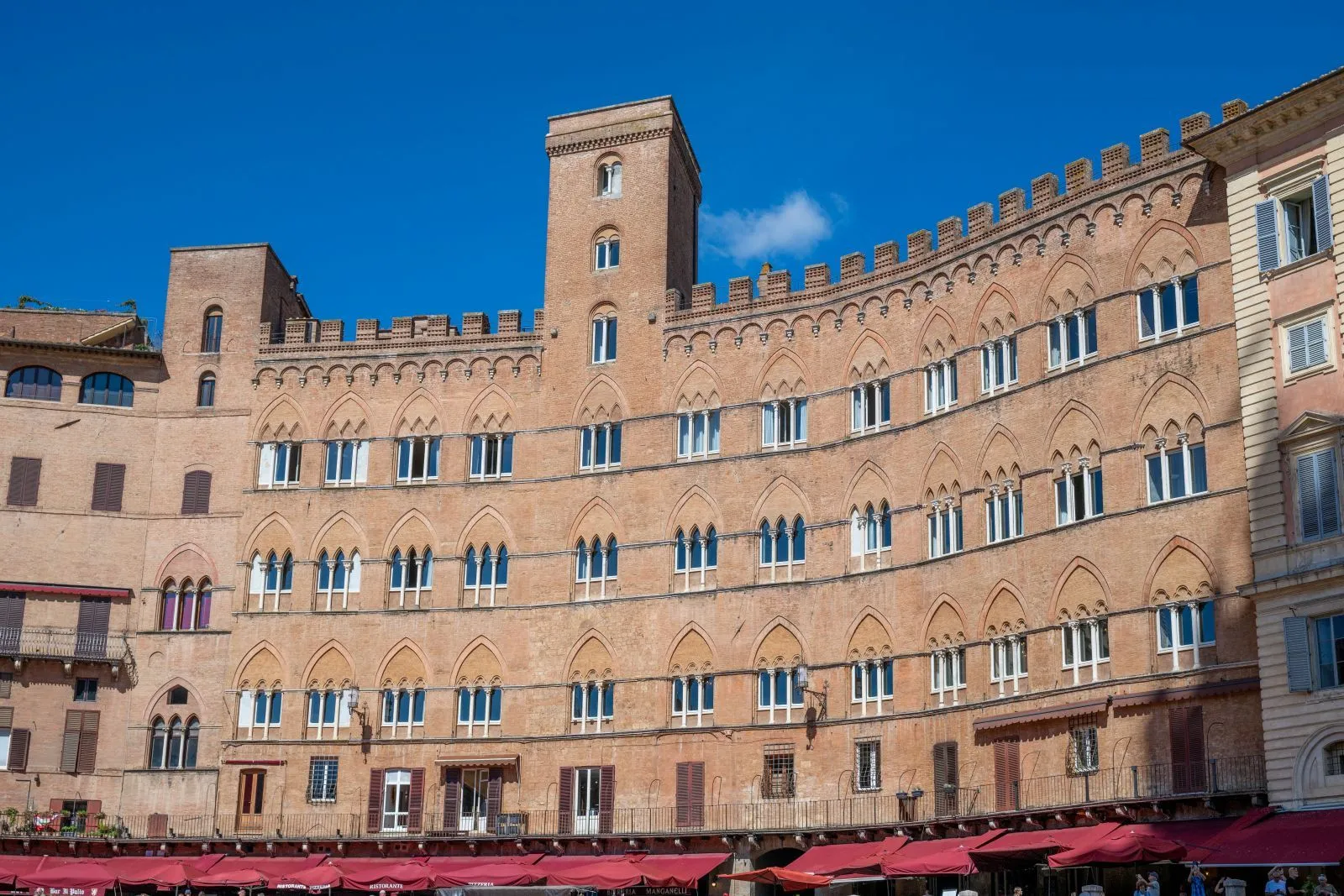
Rocca Salimbeni and Palazzo Sansedoni are located in two different parts of the historic center, but together they help tell the story of the city. The former has been linked for centuries to the history of Monte dei Paschi, while the latter overlooks Piazza del Campo and is now the headquarters of the Fondazione Monte dei Paschi di Siena.

Rocca Salimbeni
and Palazzo Sansedoni
Two historic locations in the heart of Siena
Together they illustrate the relationship between Sienese families, institutions, civic architecture, and urban memory. They are different buildings in form, function, and context, but both are central to understanding an important part of Siena's identity.
Two different places, one shared city history
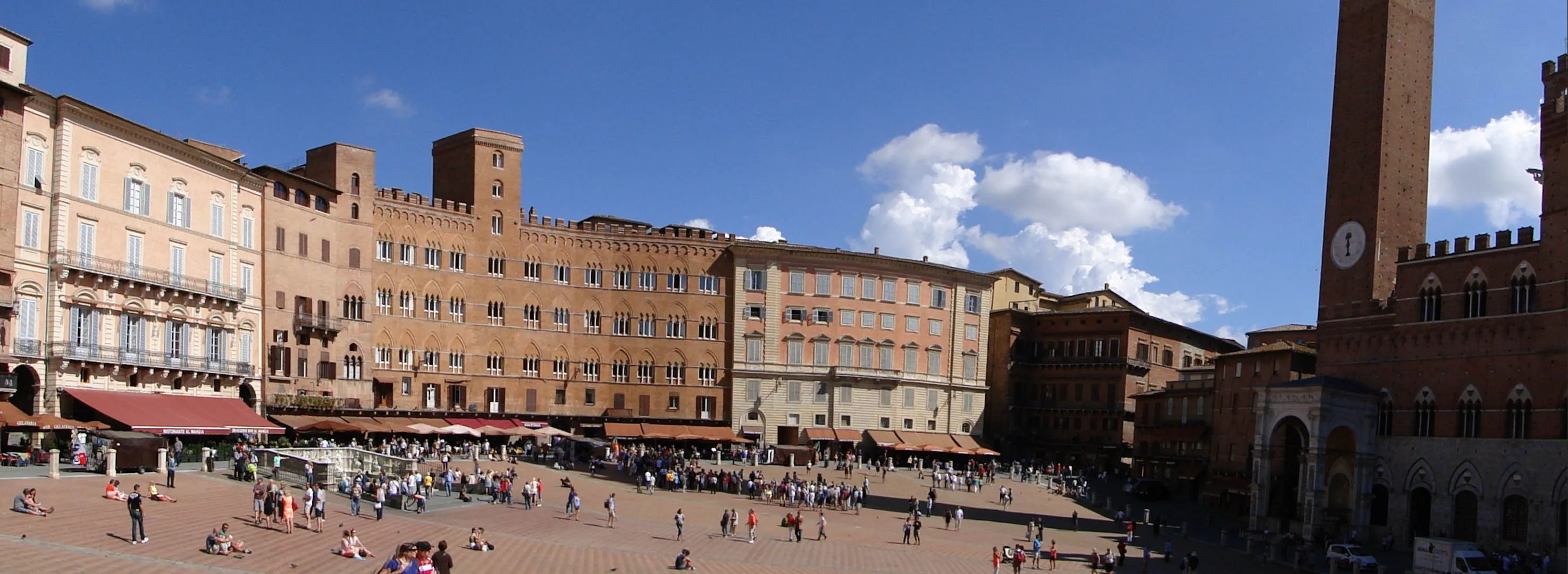
Rocca Salimbeni and Palazzo Sansedoni do not belong to the same urban space, but they recount two major aspects of Siena's history. The former overlooks Piazza Salimbeni and has been tied to the story of Monte dei Paschi for centuries. The latter dominates Piazza del Campo and is one of the most recognizable buildings in the city's skyline. Connecting them means viewing Siena through two distinct historic sites, both key to understanding the relationship between powerful families, institutions, architecture, and civic memory.
They speak different architectural languages. Rocca Salimbeni retains the compact, layered character of an ancient seat of power, which later became a public and banking headquarters. Palazzo Sansedoni gracefully follows the curve of the main square, displaying a more open and representative presence from the outside. Together, they demonstrate how Siena built its prestigious spaces over time.
Rocca Salimbeni and Piazza Salimbeni
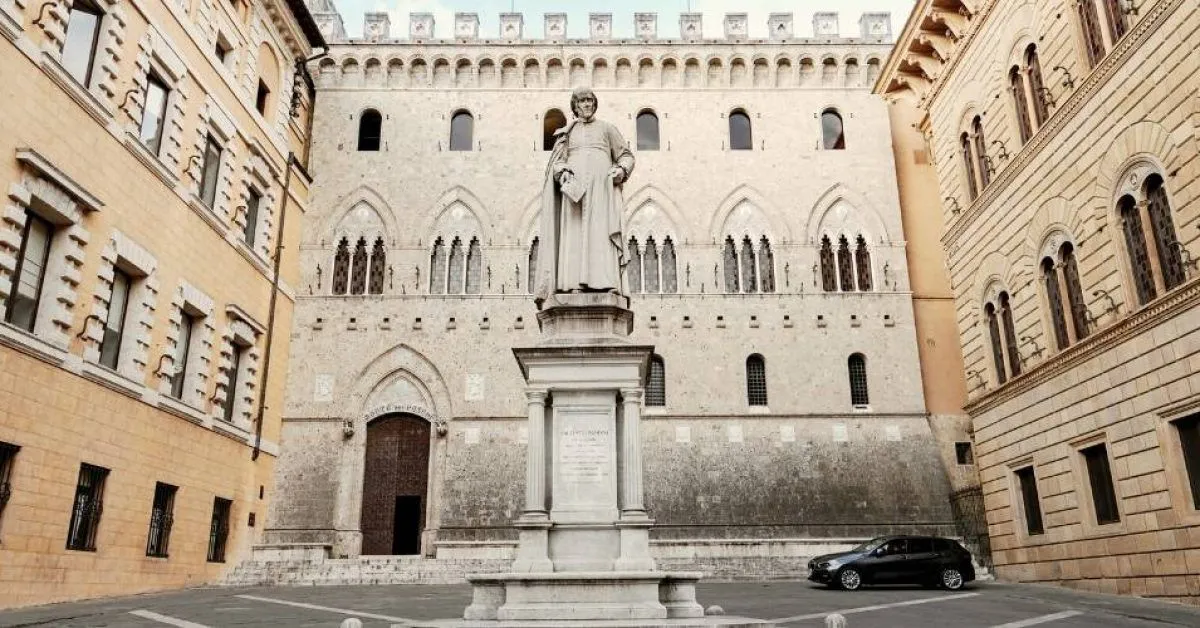
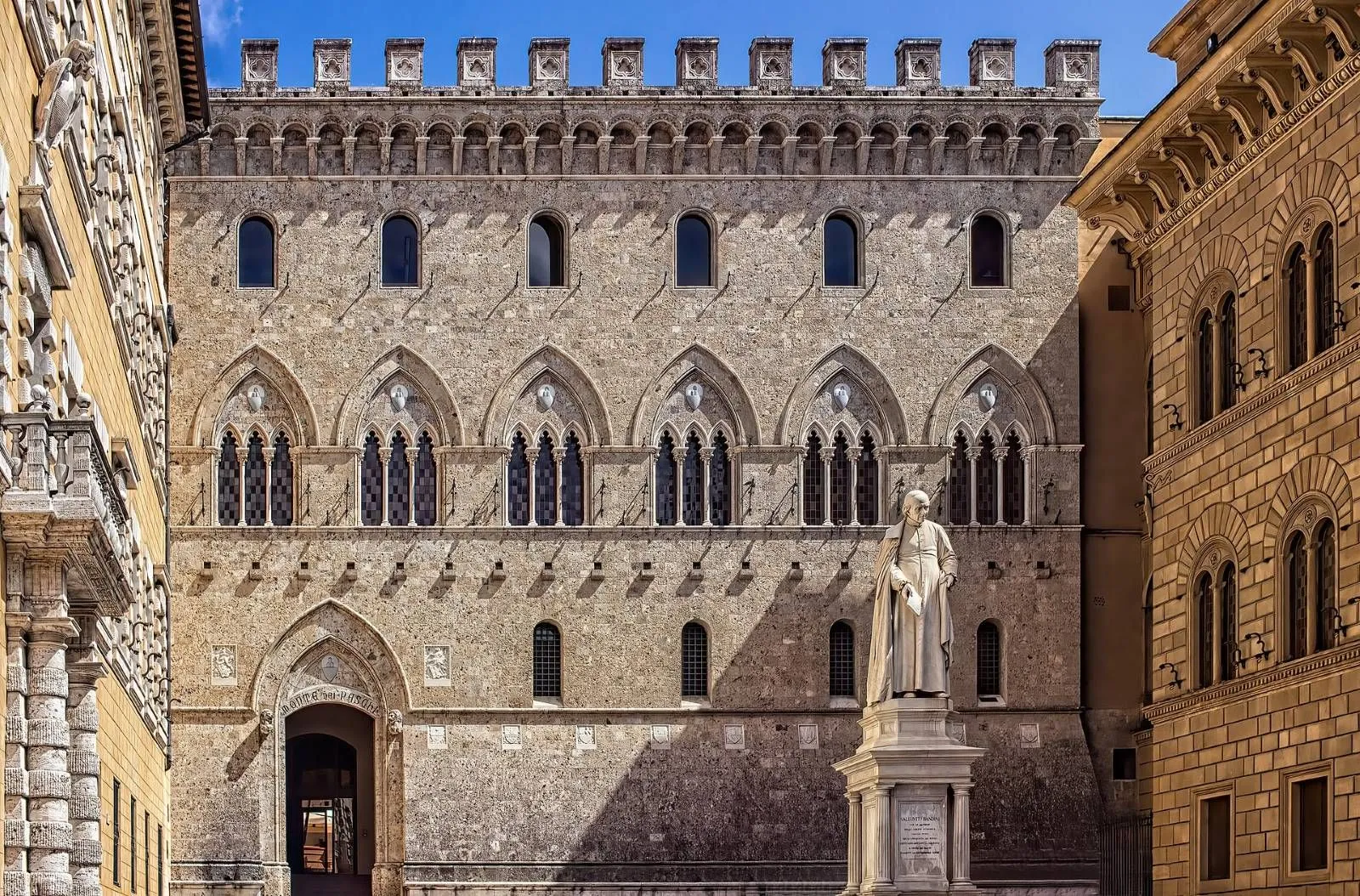
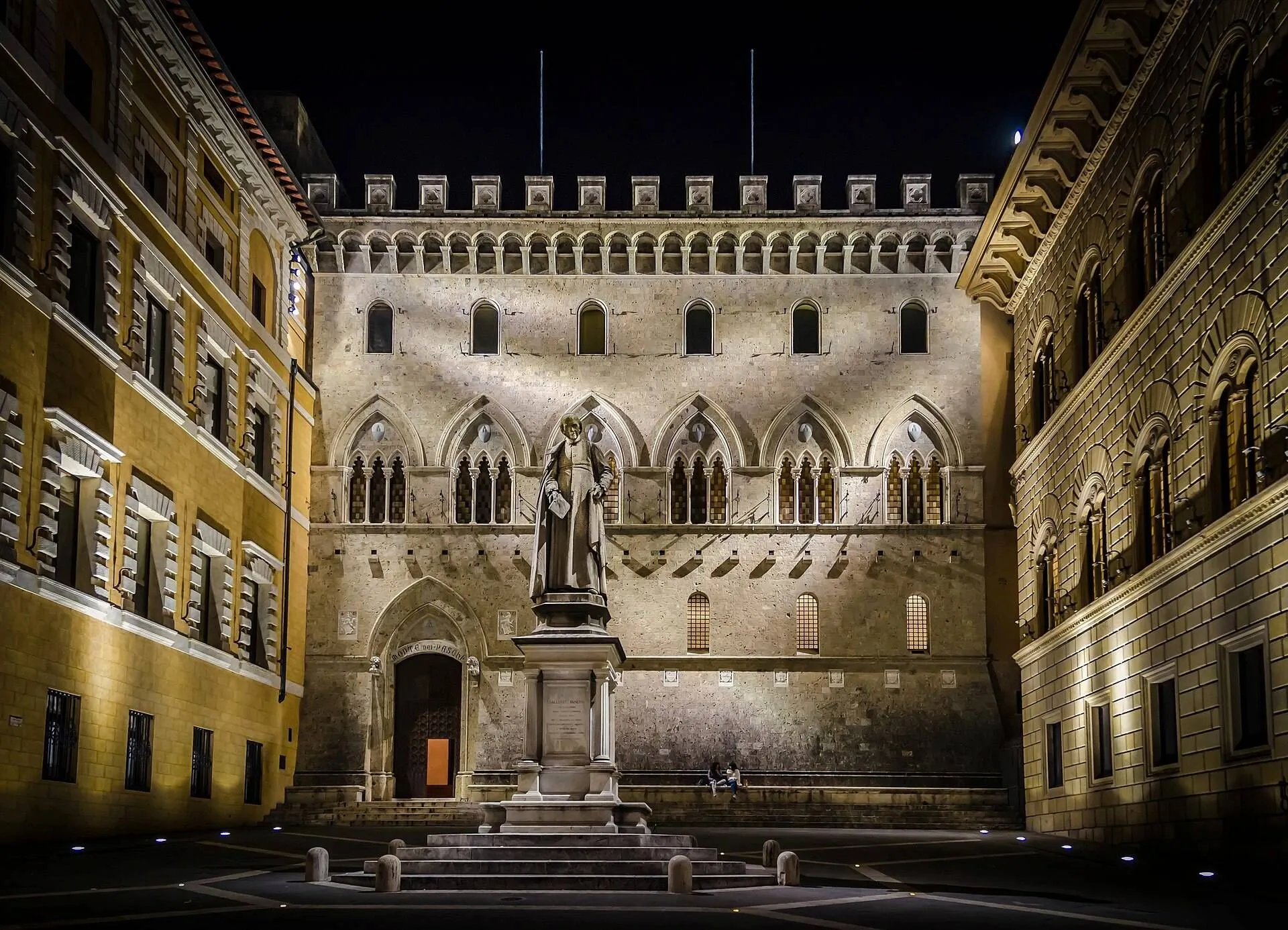
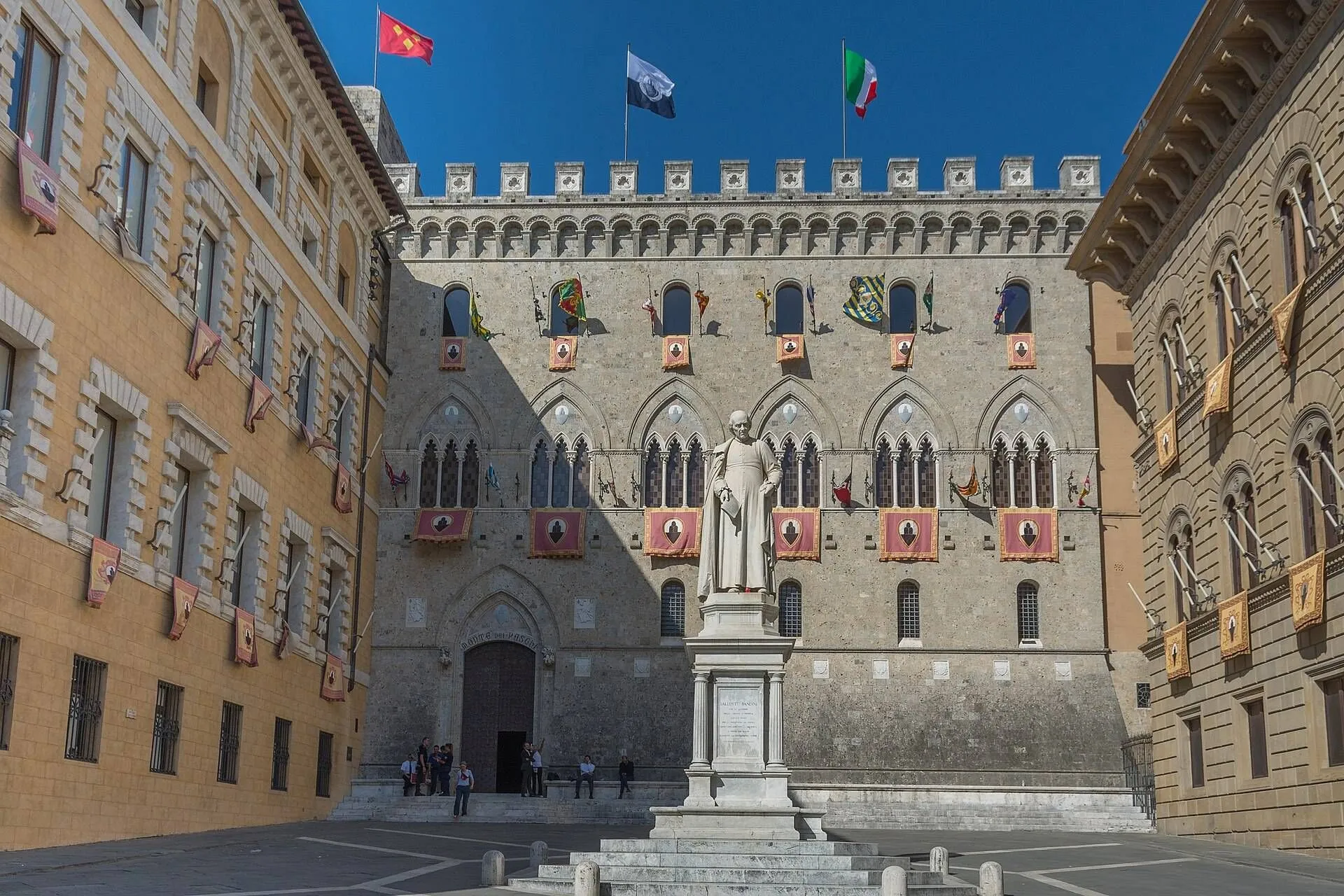
Piazza Salimbeni was not created in a unified manner. Its current form stems from transformations that occurred over time, especially between 1877 and 1879, when the area was reorganized to create a more regular space around the headquarters of Monte dei Paschi. The result is an intimate space defined by buildings from different eras, brought together by a 19th-century design that still marks its appearance today.
At its center stands the monument to Sallustio Bandini, created by Tito Sarrocchi based on a design by Giuseppe Partini. Around the square, you can recognize the medieval core of the Fortress, the Renaissance presence of Palazzo Spannocchi, and the 16th-century structure of Palazzo Tantucci. It is an ensemble that does not seek uniformity, but rather reveals the city's historical layers.
The Salimbeni fortress
The oldest core of the square is Rocca Salimbeni, now the historic headquarters of Banca Monte dei Paschi di Siena. Its name refers to the Salimbeni family, one of the most powerful in medieval Siena. Between the 13th and 14th centuries, the Salimbeni family built their wealth through trade, banking, land ownership, and control over a vast network of castles and estates.
The original complex was a castellare, a group of fortified buildings combining residential and defensive functions. For a long time, it served as the hub of their presence in the city and the location from which they managed extensive interests spanning Val d’Orcia, Maremma, and parts of Valdichiana. Its importance is underscored by distinguished guests who stayed there, including Emperor Charles IV in 1355.
In 1419, the Commune of Siena confiscated the Salimbeni family's property. From that point on, the Fortress changed function and was designated for major public offices. With the founding of Monte Pio in 1472, the area became directly connected to the history of the institution that would give rise to Monte dei Paschi. In 1866, the complex was acquired by the bank and became its main headquarters.
Restorations, tower, and heritage of the fortress
The current appearance of Rocca Salimbeni stems from restorations carried out between the 19th and 20th centuries. A decisive step was the intervention by Giuseppe Partini in 1877, which gave the complex a new unity aligned with Neo-Gothic aesthetics. In the late 20th century, a subsequent restoration was entrusted to Pierluigi Spadolini, who focused primarily on the relationship between the Fortress and the ancient tower of the castellare.
The project made the medieval structure more legible while integrating subtle contemporary elements. Walkways, staircases, glass, wood, and concrete dialogue with stone and terracotta without erasing the location's identity. The tower once again became a focal point of the complex, not only as a historical element but also as a visual anchor for the interior spaces.
The Fortress also holds a significant artistic and documentary heritage. It houses paintings, sculptures, furnishings, book collections, and archival materials that illustrate an important part of Siena's cultural history. Within the historic site's network is the Museo di San Donato, while the MPSArt portal allows online exploration of part of the Bank's collection.
Palazzo Sansedoni and the curve of Piazza del Campo
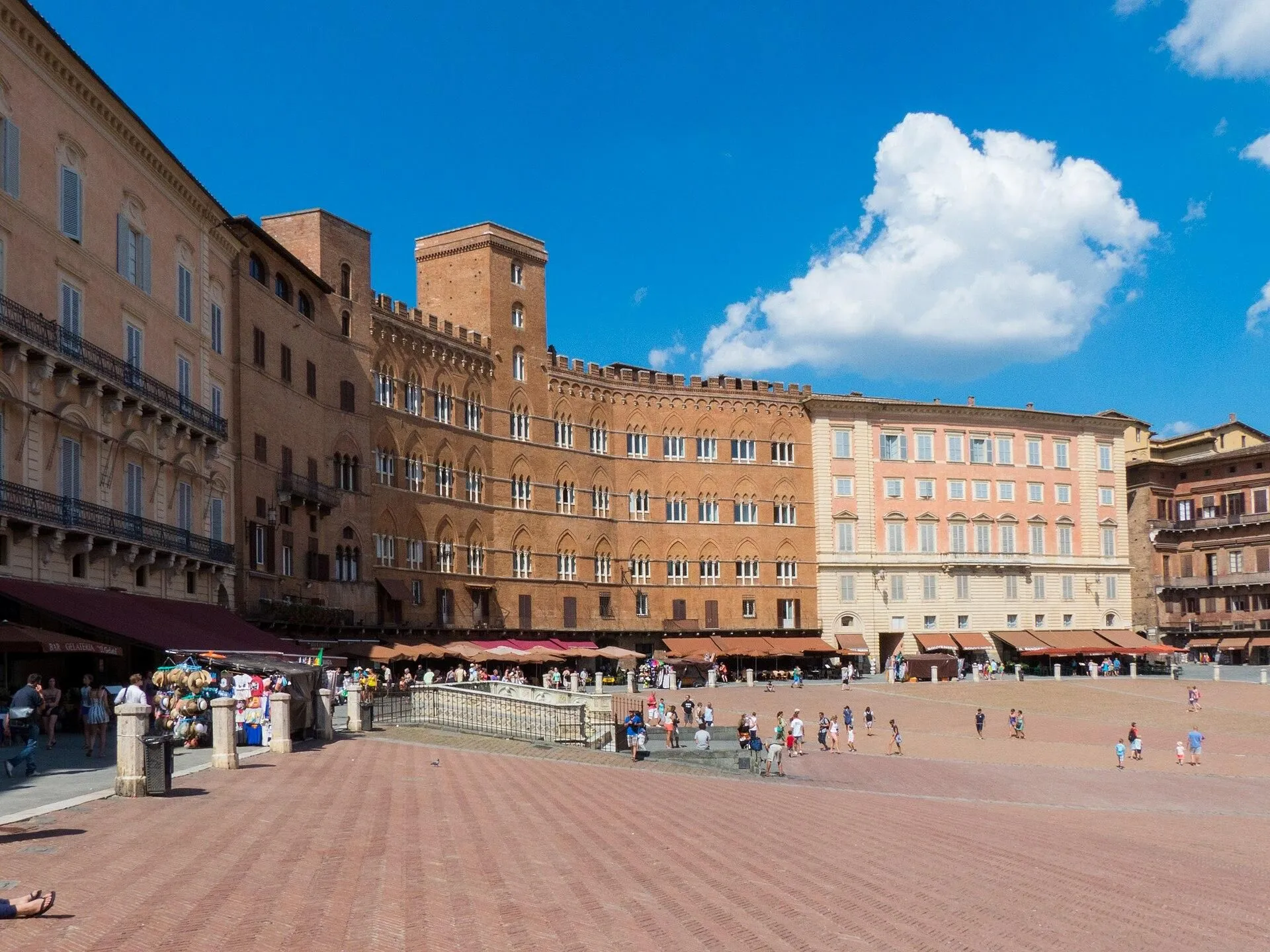
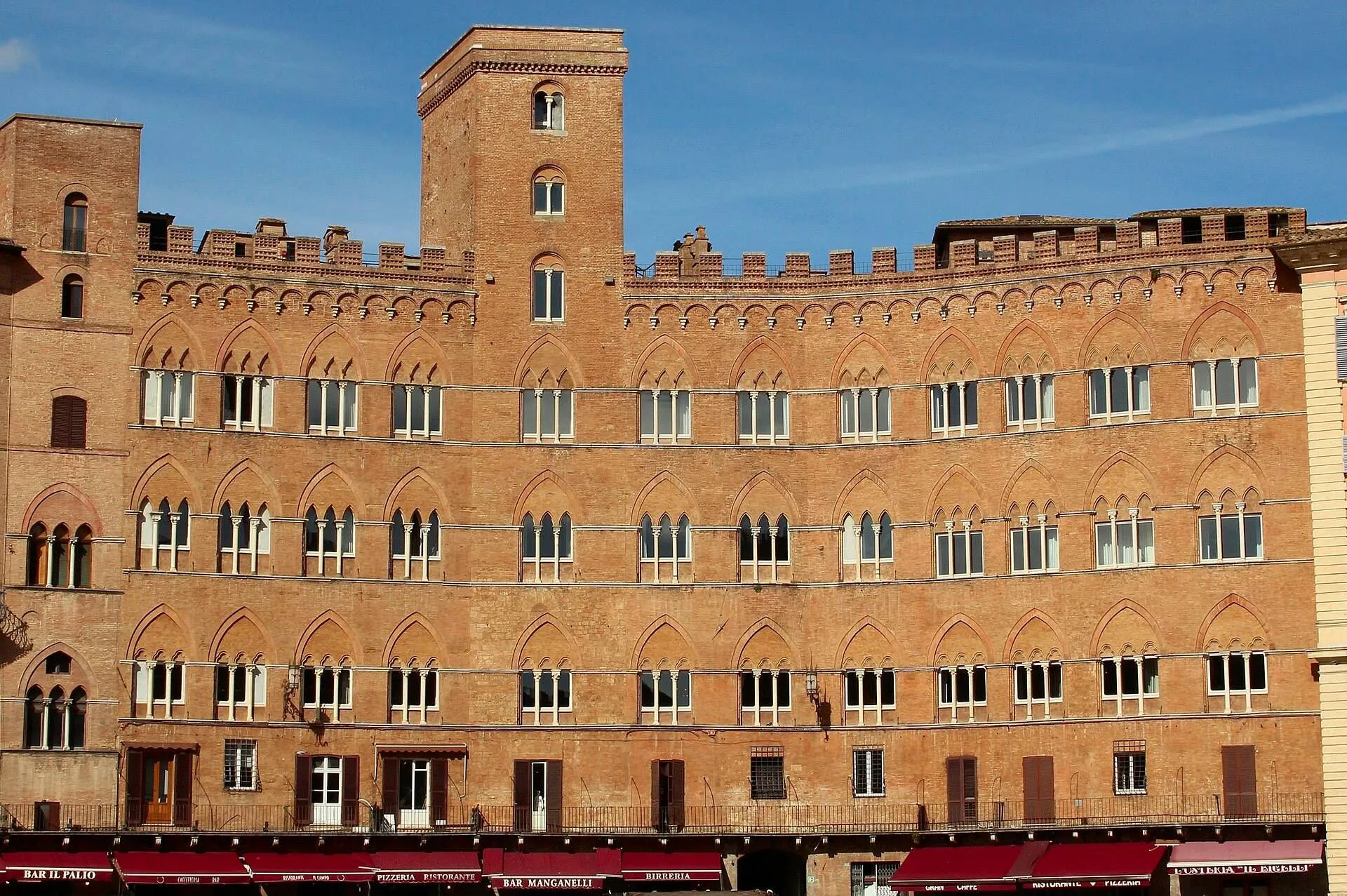
Palazzo Sansedoni is one of the most recognizable buildings on Piazza del Campo. Its façade naturally follows the curve of the square, and its rhombic tower makes it instantly distinguishable in the city skyline. It presents a strong yet proportionate presence, which is key to its architectural value.
The building has 13th-century origins and emerged from the gradual unification of several tower houses belonging to the Sansedoni family, a prominent lineage in medieval Siena. In the 14th century, the palace took on a more monumental form, undergoing further changes over the centuries to achieve its present look.
One of its distinct features is how it adheres to the layout of the square. Among the palaces lining the Campo, it highlights Sienese architecture's ability to adapt to urban space without losing a strong identity.
The Sansedoni family and Blessed Ambrogio
The name of the palace is tied to the Sansedoni family, particularly Blessed Ambrogio Sansedoni (born 1220, died 1286), a key 13th-century figure in Siena known for his religious, social, and public role. His memory remains vibrant in the city: a bust of him is displayed on the facade of the Cathedral, and for a long time, a Palio was dedicated to him.
This link between family history, devotion, and civic memory makes the palace significant not only for its architecture but also for its place in the Sienese identity. Palazzo Sansedoni is more than a major landmark on the Campo; it preserves traces of a familial and religious legacy still visible in the city's history today.
Interiors and the role of the palace today
While the exterior impresses with its location and connection to Piazza del Campo, the interior is notable for its rich decoration. The palace houses remarkable frescoes and ornaments, especially in the rooms decorated in the 18th century by Francesco and Giuseppe Melani and Gian Domenico Ferretti.
Of particular note is the chapel dedicated to Blessed Ambrogio Sansedoni, commissioned by Rutilio Sansedoni, featuring a ceiling painted by Anton Domenico Gabbiani. This space is considered one of the finest examples of Baroque taste in Siena. The interiors also feature works and features attributed to masters such as Mazzuoli, Soldani, and Foggini.
Today, Palazzo Sansedoni is the headquarters of the Fondazione Monte dei Paschi di Siena. Its current function keeps it vibrant, playing an active role in preserving historic and artistic heritage while housing an institution central to the city's cultural life.
Two sites to view together
Rocca Salimbeni and Palazzo Sansedoni present different narratives and should not be confused. The former focuses on continuity between family power, public roles, banking history, and urban transformations. The latter highlights the relationship between grand civic architecture, family lineage, art, and presence in one of the city's most famous landmarks.
Viewed together, they reflect a signature trait of Siena: the city does not strictly separate political history, religious life, prominent families, and urban form, but rather weaves them together. For this reason, despite their distance and differing characters, both buildings help elucidate an essential part of Sienese identity.