The Fosso di Sant'Ansano: where it all began
This place is dedicated to Sant'Ansano, one of the four patron saints of Siena, celebrated on December 1st, a very special date for the Sienese because it also marks the beginning of the new contrada year.
According to tradition, Sant'Ansano arrived in Siena at the beginning of the 4th century to spread Christianity. Here he began to preach and baptize the citizens, but he attracted the attention of the Roman authorities during the persecutions of Emperor Diocletian.
The trial by fire and boiling oil
It was in the Fosso di Sant'Ansano that one of the most extraordinary episodes of the saint's life took place.
After being arrested, Sant'Ansano was sentenced to a terrible trial: he was immersed in boiling oil and subjected to fire. But, according to legend, a miracle occurred. The pot suddenly overturned, the oil extinguished the flames, and the saint emerged completely unharmed.
An episode that still lives on in the memory of the city and is commemorated by a marble plaque placed along the ditch.
The martyrdom of Sant'Ansano and the return of the Saint to Siena
After the miracle, Sant'Ansano was imprisoned again and transferred to Dofana, in the territory of present-day Castelnuovo Berardenga, where he was beheaded on December 1st, 304 (according to some sources in 303).
However, his story does not end here.
It is said that in 1108, Bishop Gualfredo convinced some Sienese to secretly recover the relics of Sant'Ansano to finally bring them back to the city and give him burial in the Duomo di Siena.
When the procession entered through Porta Pispini on February 6, 1108, the people welcomed the patron with a cry destined to become legend:
"The Saint is coming! The Saint is coming!"
From here the ancient name of Porta San Viene, now, indeed, Porta Pispini
The Fosso di Sant'Ansano, a pilgrimage destination in the Middle Ages
For many centuries, the Fosso di Sant'Ansano was a fundamental stop for pilgrims.
Those who visited Siena followed a true itinerary dedicated to the saint, which included the Fosso di Sant'Ansano, the ancient Prisons of Sant'Ansano, and the location of Dofana, the scene of his martyrdom.
Walking today in this small corner of the city means retracing one of the most important spiritual paths of medieval Siena.
A hidden treasure for the urban history of Siena
The Fosso di Sant'Ansano is important not only for its religious history.
It was here that the first medieval city wall of Siena passed, built between the 9th and 11th centuries, when the city began to take on the shape we still know today.
Walking along the ditch, one can read, almost like the pages of a book, centuries of urban transformations.
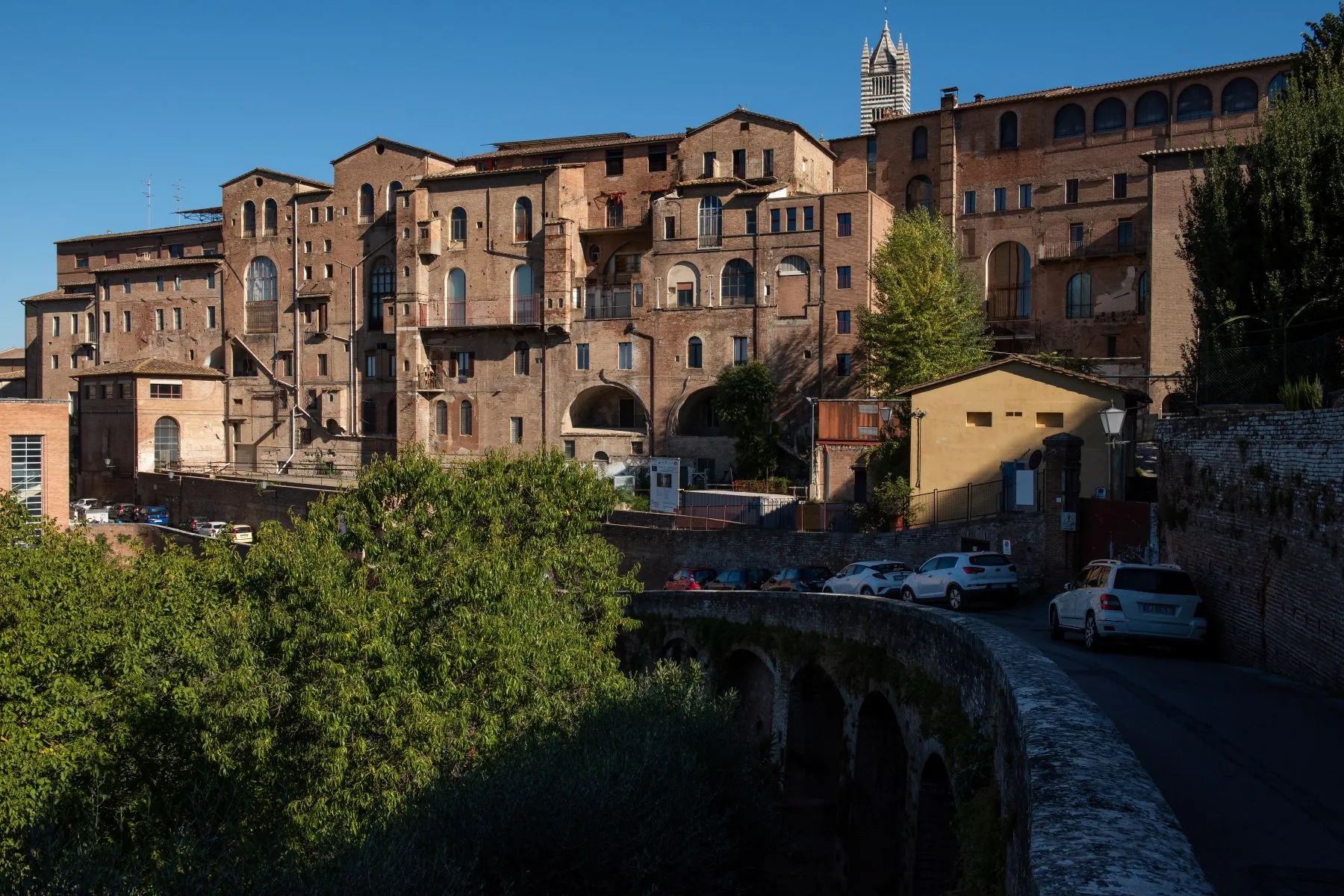
A hidden viewpoint over Santa Maria della Scala
One of the most surprising aspects of the Fosso di Sant'Ansano is the view.
From here, one can observe the Santa Maria della Scala Museum Complex from a completely different perspective than that of Piazza del Duomo. One can admire the ancient medieval walls, the supporting arches, and the lower levels of the building, normally hidden from the eyes of visitors.
It is an unusual, original, and still little-known glimpse, perfect for those who love to discover the most authentic Siena and less crowded.
Why visit the Fosso di Sant'Ansano
The Fosso di Sant'Ansano is much more than just a historical place.
It is a space where legends, history, spirituality, and the identity of Siena meet. It is one of those places that surprise precisely because they almost never appear among the most famous attractions, but that manage to offer authentic emotions to those who decide to linger a few more minutes.
If you love to discover the most hidden corners of Siena and let yourself be guided by the stories that time has preserved for centuries, the Fosso di Sant'Ansano is a stop that cannot be missed on your itinerary