A knight who is not forgotten
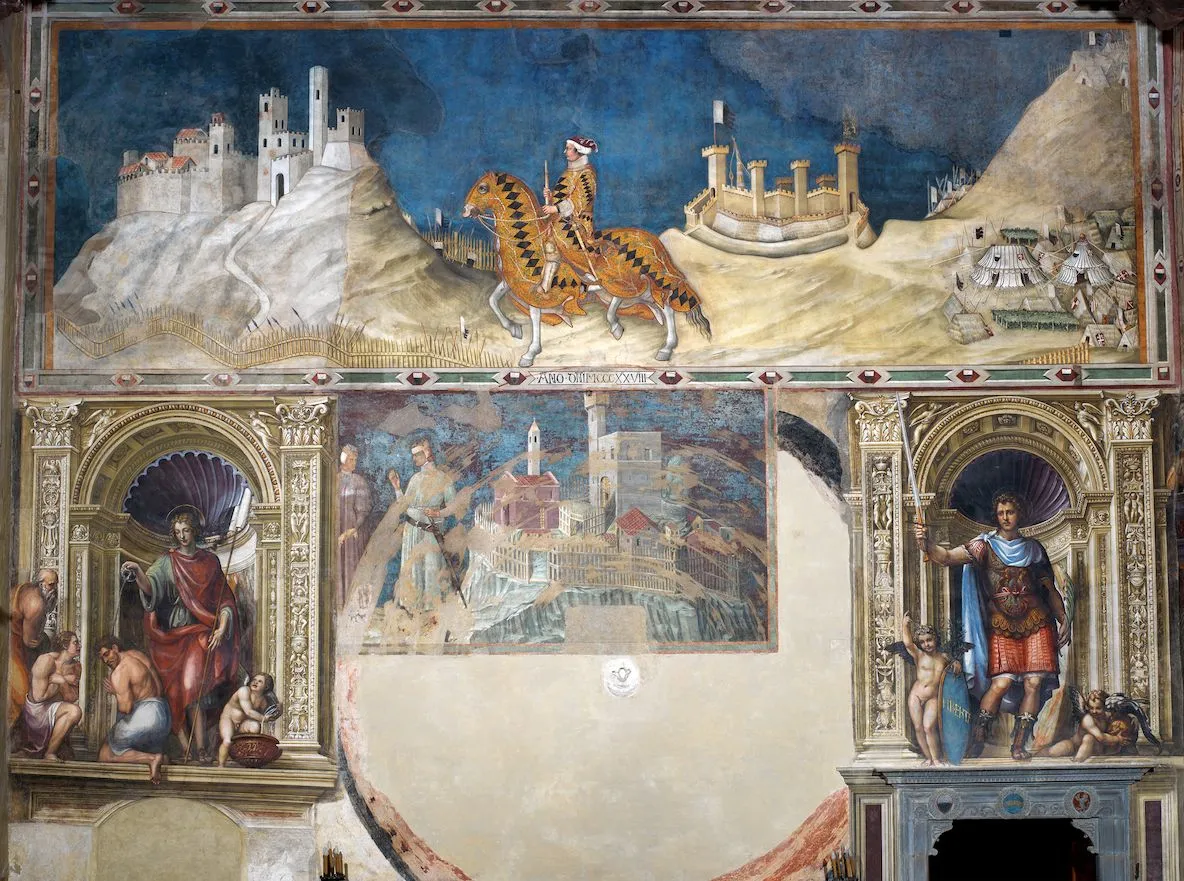
There is a moment, upon entering the Hall of the World Map of the Palazzo Pubblico of Siena, when one stops. Not by a conscious choice, but because something catches your eyes and does not release them immediately. It is he: Guidoriccio da Fogliano, alone, solemn, advancing on a horse with a proud stride through a landscape that seems suspended outside of time.
Traditionally attributed to Simone Martini and dated 1330, the fresco depicts the leader Guidoriccio da Fogliano during the conquest of the castle of Montemassi, a military victory of the Republic of Siena. An image that has become over time a visual symbol of the city: elegant, mysterious, unrepeatable.
A masterpiece of medieval propaganda
The Guidoriccio is not just a beautiful painting. It is a political act. A powerful message that the Republic of Siena wanted to entrust to art to celebrate its military victories and the skill of its condottieri.
The knight, with his richly decorated cloak and solemn bearing, embodies the ideal of the faithful and valiant leader, in total service to the city. Behind him, a landscape of castles, towers, military tents, and geometric hills that represents one of the first topographical descriptions in the history of art: precise, recognizable, almost cartographic.
The mystery of attribution
A fresco beneath the fresco
One of the most fascinating aspects of the Guidoriccio is that not everyone is certain of who painted it. The attribution debate has been heated for decades: some scholars have hypothesized that the work is not by Simone Martini, but by a later artist, perhaps from the 15th century.
The discussion intensified after the discovery, beneath the fresco, of another older scene: the conquest of Arcidosso, likely the work of Simone Martini himself. A painting hidden beneath a painting, like a secret that the wall has kept for centuries.
The charm of doubt
Despite the debate — or perhaps precisely because of it — the Guidoriccio continues to exert extraordinary charm. Its solitary and elegant figure, the stylized landscape, the suspended atmosphere reminiscent of chivalric novels: all contribute to making it something more than a work of art. It is a legend painted on the wall.
Come see it
To see the Guidoriccio in person in the Hall of the World Map means to immerse oneself in 14th-century Siena: wars, alliances, artistic splendor, and the proud awareness of a city that knew how to tell its own story with extraordinary visual power.
Enter the Palazzo Pubblico, raise your eyes, and let yourself be stopped. Certain paintings are not looked at: they look at you.
Hall of the World Map, Palazzo Pubblico, Piazza del Campo, Siena.