 museocivicosiena@operalaboratori.com
 +39 0577 286300
A wall that changes everything
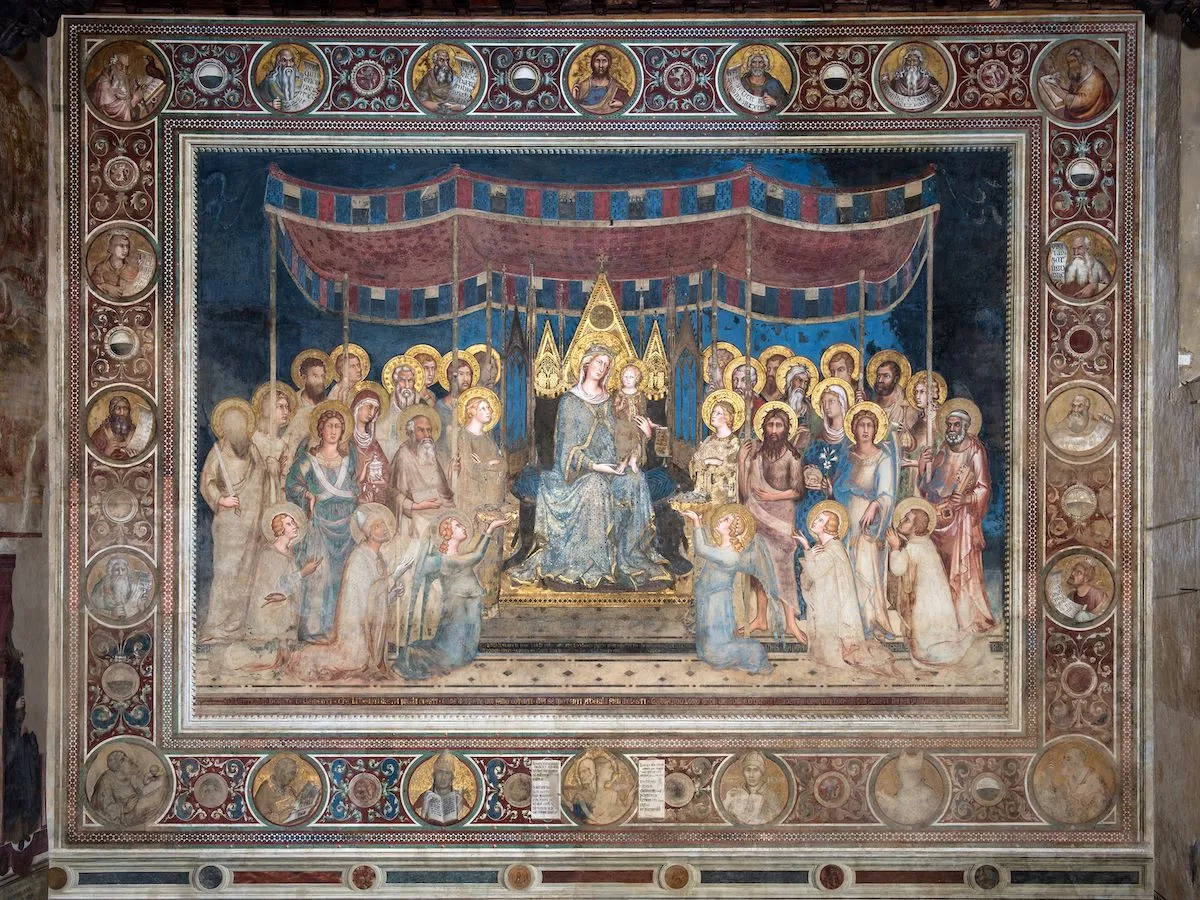
You enter the Sala del Mappamondo of the Palazzo Pubblico and you stop. Not by choice, but because the wall in front of you simply won't let you pass. It occupies the entire visual space, all the attention, all the oxygen in the room. It is Simone Martini's Maestà, and after nearly seven hundred years it still does precisely that: it stops anyone who gazes upon it.
Painted in 1315 on commission by the Government of the Nine—the very rulers of Siena during one of its most brilliant eras—and restored by Martini himself in 1321, this is the hall where the city’s General Council assembled. It is no coincidence that the Virgin Mary sits right there, on that wall: she was there to watch over those making the decisions, reminding the rulers every day that power came with a price, and its name was justice.
A Virgin Mary engaged in politics
At the center of it all is her: the Virgin Mary enthroned, surrounded by a celestial court of angels and saints beneath a magnificent golden canopy. Saints Ansanus, Sabinus, Crescentius, and Victor, the city's patron saints, act as her intermediaries—like ambassadors between heaven and Siena. It is an image combining power and gentleness, blending the sacred and the civic until they become indistinguishable.
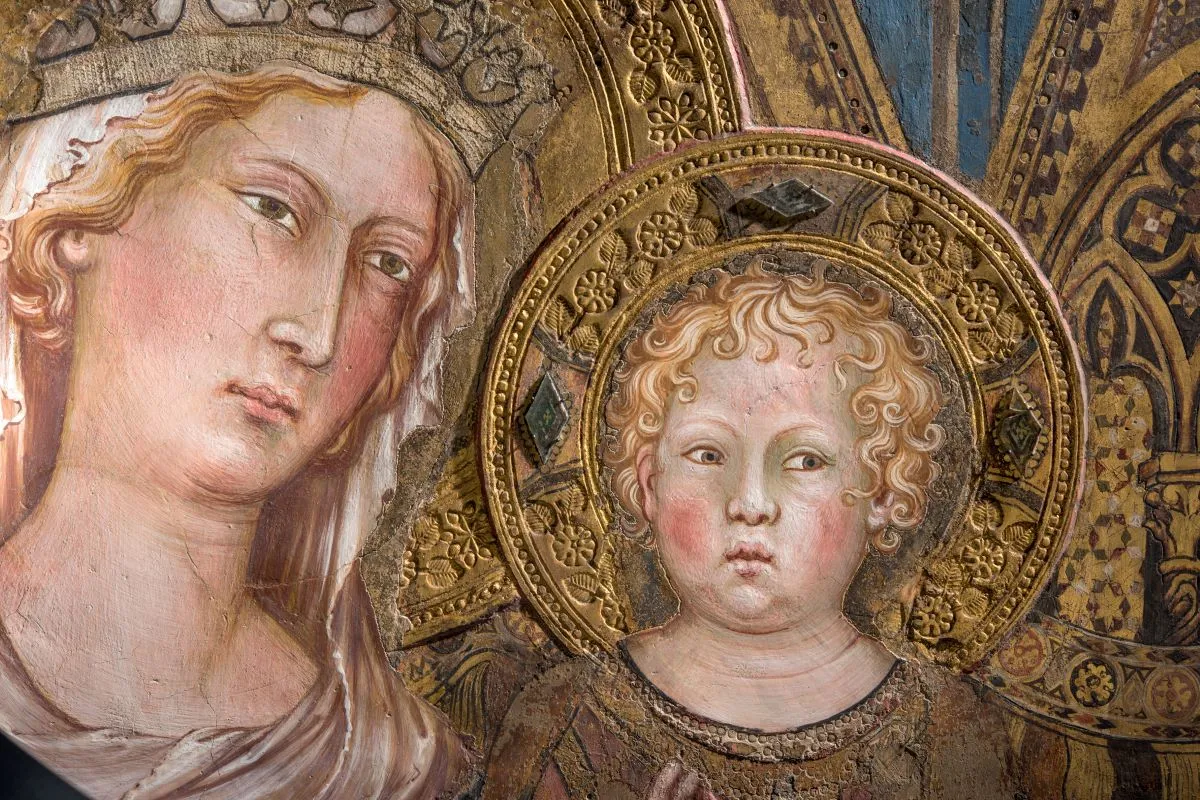
Yet it is the Infant Jesus who delivers the most important message. He holds a scroll with a line no ruler could afford to ignore: "Diligite Iustitiam qui iudicatis terram" — "Love justice, you who judge the earth." This was no vague exhortation; it was a direct message, almost a gentle threat aimed at those who sat in that room every day making decisions affecting thousands of lives.
Simone Martini's Virgin Mary is not merely a religious figure. She is a symbol of good governance, an advisor to the powerful, a voice for the voiceless. A political presence disguised as devotion—or perhaps a devotion so profound it becomes inherently political.
Materiality, color, and wonder
An artwork that blends everything
Looking at it up close reveals how extraordinarily tactile and textured it is. Simone Martini was not satisfied with paints on plaster alone: he used rock crystals for the Virgin's mantle, glass inlays in the throne, parchment, and metallic foils to lend depth and splendor to every detail. Azure and gold dominate the scene, endowing the artwork with a level of refinement that feels almost impossible for a fresco.
In the outer frame, roundels depict evangelists and prophets alongside the city’s emblems: the black-and-white balzana shield and the rampant lion. All of Siena, enclosed around its Virgin.
Simone Martini and Duccio, a dialogue between masters
Simone Martini had an undeniable model before him: Duccio di Buoninsegna's Maestà, created between 1308 and 1311 and housed today in the Museo dell'Opera del Duomo. Martini drew upon Duccio's arrangement of saints, facial features, and throne design. But then he ventured further: he rendered the figures more elegant, made the Virgin sweeter and more human, and crafted richer, more sophisticated ornamentation. Above all, he added a political and civic dimension absent from Duccio's work, turning a sacred icon into a manifesto of governance.
Come stand before her
Simone Martini's Maestà is located in the Sala del Mappamondo inside the Museo Civico at Palazzo Pubblico. It is not inside just any museum: it stands in the very room where the rulers of Siena once sat to govern, with the Virgin looking down on them from above. Step inside, look up, and let yourself be observed. Because certain paintings aren't just for you to look at: they are looking at you.