Five centuries of work, a single vision
From the Fourteenth to the Eighteenth Century: an unprecedented collective work
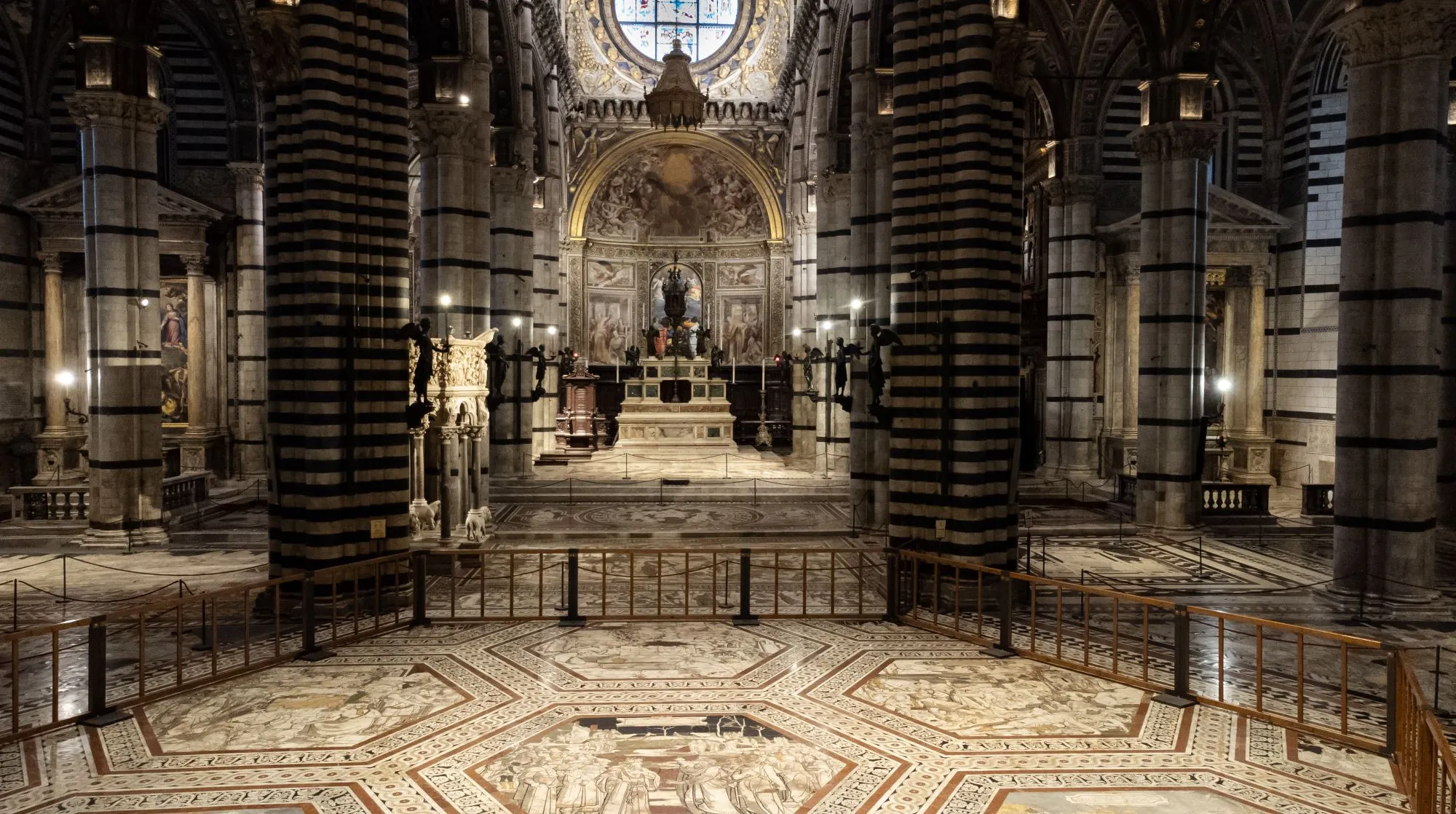
The first inlays date back to the Fourteenth Century: geometric patterns and symbolic figures that open the path like a prologue. Then, between the Fifteenth and Sixteenth Centuries, the project explodes in its full grandeur, involving the greatest Sienese Renaissance artists in an undertaking that has no comparison in the history of art. Over sixty inlays created with marble inlay and graffiti techniques, capable of achieving almost pictorial effects by working exclusively with stone, chiaroscuro, perspectives, movements that seem impossible for such a rigid and definitive material.
The great masters and the most extraordinary scenes
Beccafumi: chiaroscuro in marble
The genius of Domenico Beccafumi signs some of the most spectacular scenes of the entire floor: The Massacre of the Innocents, Moses on Sinai, Elijah, compositions of dramatic power that use marble chiaroscuro in a revolutionary way, transforming stone into pure emotion.
Pinturicchio and the Mount of Wisdom
Pinturicchio, the only non-Sienese artist involved in the project, signed the famous Mount of Wisdom in 1505: an allegory of the human journey towards knowledge and virtue, one of the most evocative and philosophically rich scenes of the entire cycle. Alongside him, masters like Sassetta, Neroccio di Bartolomeo de' Landi and Matteo di Giovanni enrich the path with biblical and allegorical scenes of extraordinary refinement.
The Wheel of Fortune and the Sibyls: an initiatory journey
The iconographic path accompanies the visitor from the nave to the altar in a precise symbolic journey: it starts from figures of antiquity like Hermes Trismegistus and the Sibyls, crosses the central hexagon under the dome with the Wheel of Fortune and the stories of the Jewish people, up to the episodes of the great biblical prophets. Many scholars interpret the entire cycle as an initiatory path: a journey from earthly knowledge to spiritual revelation, written in marble for those who have eyes slow enough to read it.
A rare privilege: the uncovered floor
Only from late August to late October
To protect it, the floor of the Cathedral remains covered for most of the year. Only for a few weeks, from late August to late October, it is uncovered and returned to the visitor's gaze in its entirety. A rare appointment, almost an event, that makes the visit during this period something special and unrepeatable. The care with which Siena has preserved it for centuries tells better than any word the deep bond between this city and its Cathedral.