Duccio di Buoninsegna: the man who changed Sienese painting
A bridge between Byzantium and Gothic, between tradition and modernity
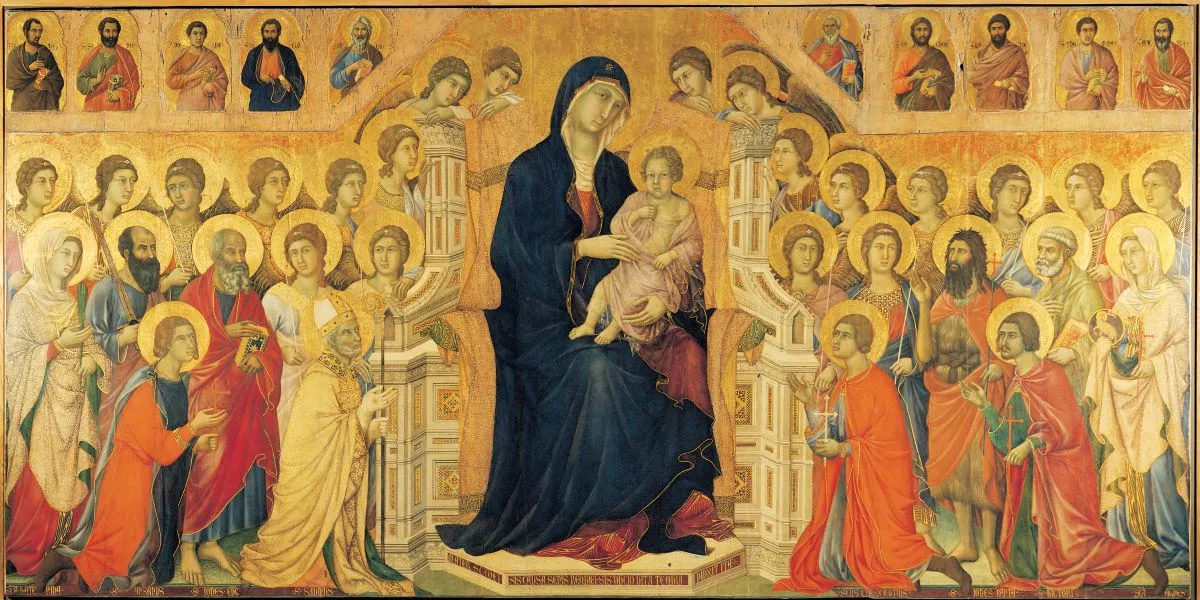
The Maestà was created between 1308 and 1311 for the main altar of the Cathedral of Siena: a monumental work, painted on both sides, designed to be seen by the entire city during solemn celebrations. Duccio di Buoninsegna was the undisputed master of the Sienese painting school, and in this work, he reached the pinnacle of his art. What makes the Maestà revolutionary is not just its grandeur, but its sweetness. Duccio introduces a new tenderness in the faces, a delicacy in the gestures that medieval painting had not yet dared to explore. His intense blues, deep reds, and luminous golds, obtained with precious pigments that cost as much as spices, are not just colors: they are symbols of the spiritual and political greatness of a city at the height of its power. With the Maestà, Duccio paves the way for a more narrative, more intimate, and more human painting. It is the boundary between the Byzantine and Gothic worlds, and he crosses it with a grace that still takes one's breath away.
The Virgin, Queen of Siena: much more than a sacred image
An identity symbol that has protected the city for centuries
The Virgin is depicted seated on a throne with the Child, surrounded by a court of angels and saints who seem to move in a sacred and suspended silence. But she is not just the Mother of God: she is the Queen of Siena, the protector of the city, the symbol of the collective identity of an entire people. For centuries, the Sienese believed that the Maestà watched over them, and in that collective faith lies something that no stylistic analysis can ever fully explain. Duccio signed the work with a phrase that is almost a prayer: an act of devotion and artistic pride together, as if he knew he had created something that would outlive him forever. "Holy Mother of God, be the cause of rest for Siena, be life for Duccio, for he has painted you thus".
The back of the altarpiece: the Passion of Christ in small human scenes
A narrative cycle of extraordinary emotional intensity
On the back of the altarpiece, now visible at the Museum of the Opera del Duomo, unfolds a narrative cycle dedicated to the Passion of Christ: small scenes rich in detail, emotion, and surprising humanity. Stories painted with the same care and intensity as the front, in an intimate format that compels one to stop, draw closer, and look. It is here that Duccio's greatness reveals itself in all its human measure. Today, at the Museum of the Opera, it is possible to admire the Maestà from a distance impossible in the Cathedral: to see up close the fineness of the details, to read the faces, to perceive the quality of the pigments. A privilege that medieval Sienese never had, making this visit even more precious.