An oratory born to communicate values
The Oratory was not conceived as a parish church, but as a place of spiritual propaganda. The decorations served to visually teach the values preached by the saint, especially to illiterate believers.
The frescoes depict the life and miracles of San Bernardino as an illustrated story, with a precise narrative arrangement.
Architecture, frescoes, and decorations
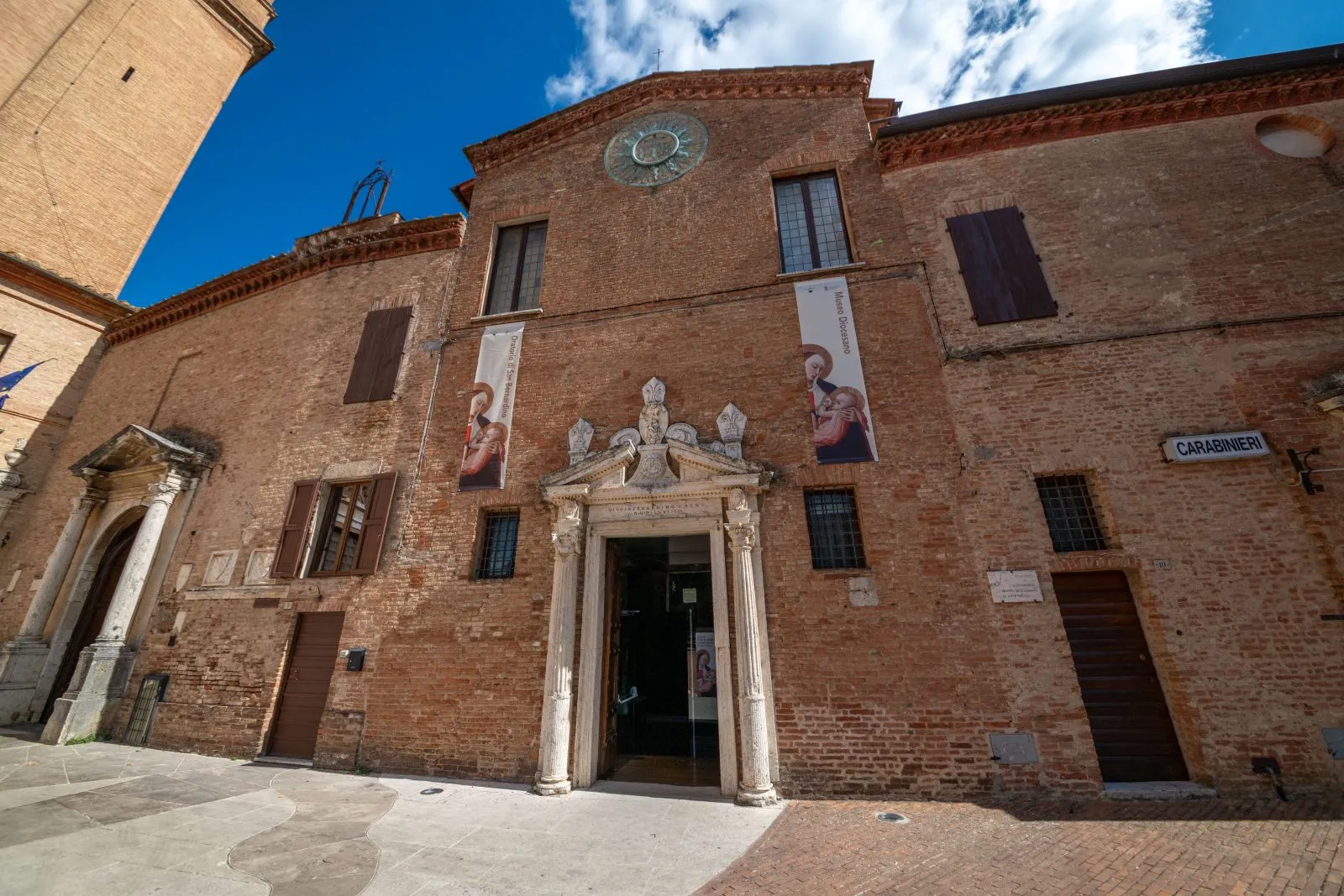
The gabled brick facade is enriched by a travertine portal dated 1574 and, at the top, by a radiating disc with the bernardin trigram JHS.
The Oratory is organized on two levels: the upper floor, the oldest, retains a coffered ceiling decorated with heads of cherubs and wooden walls with stucco decorations by Ventura Turapilli, created between 1496 and 1512.
Between the pillars unfolds the famous cycle of frescoes with Stories of the Virgin, created between 1518 and 1532 by Sodoma, Girolamo del Pacchia, and Beccafumi. In these works, references to the Roman experiences of Michelangelo and Raphael are evident, particularly to the ceiling of the Sistine Chapel and the Vatican Rooms.
Artworks and Diocesan Museum
Alongside the frescoes, the Oratory houses significant works such as the Byzantine Icon of Our Lady of Mount Carmel, the 13th-century panel by Guido di Graziano, the Madonna of Vignano by Bartolo di Fredi, the Madonna of Molli by Sassetta, and the Madonna of Milk by Ambrogio Lorenzetti.
Since 1999, in the adjacent rooms, the Diocesan Museum of Sacred Art has been set up.
History of the Confraternity
The Confraternity, known as Santa Maria e San Francesco in 1273 and later as the Madonna della Veste Nera di San Francesco in the 14th century, took the title of San Bernardino in 1450, after the canonization of the saint from Siena.
In the second half of the 15th century, it decided to build the Oratory. By the end of the century, the building was already completed; followed by the stuccos and wooden decorations, then the fresco decoration of the upper floor in the first half of the 16th century and that of the lower floor between the end of the 16th and the beginning of the 17th century.
Curiosities and popular devotion
During his sermons, Bernardino invited people to burn playing cards, mirrors, cosmetics, and books deemed immoral. It is said that the piles were enormous, true anticipations of the “bonfires of vanities” in Florence.
Many mothers brought sick children in front of the Oratory, convinced that San Bernardino had a special power to protect childhood.
The Oratory is open from 04/01 to 10/31.