A Gate That Doesn't Shout
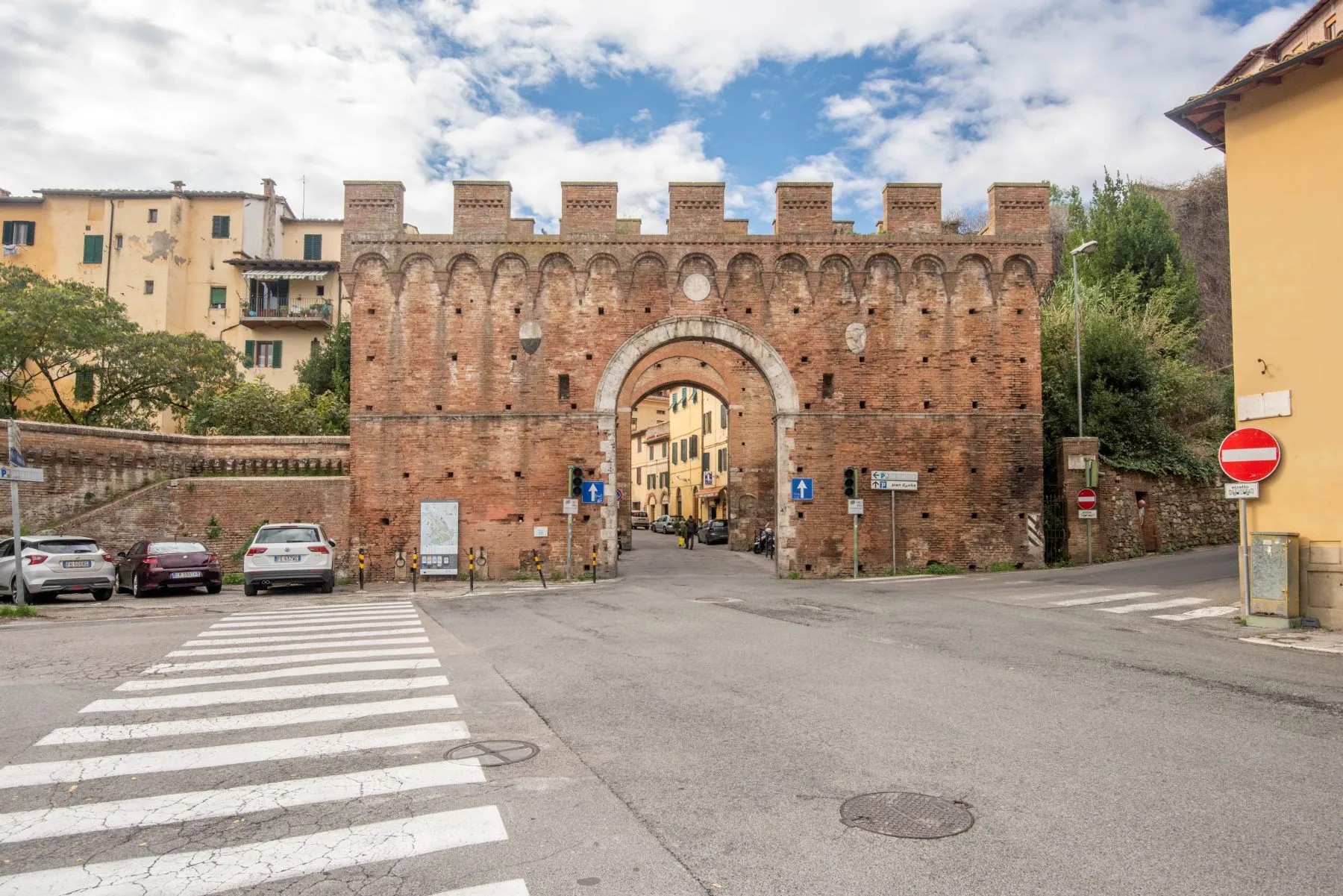
There are places that impose themselves, and places that offer themselves. Porta Ovile belongs to the second category. It doesn't stop you with its monumentality, it doesn't try to surprise you with gold or marble. It waits for you, discreetly, nestled in the hill of Terzo di Camollia as if it has always been there, and indeed it has.
Built around the mid-13th century, during an important period of growth for the city, Porta Ovile was born with a simple and fundamental task: to connect the urban center with the surrounding countryside, to create a passage between the life of the square and the work in the fields. A daily opening, not a triumphant one. And perhaps for this reason, more honest than many others.
Stone, Symbols, and Devotion
The architecture is solid, compact, almost gathered in on itself. The double gate tells of a time when defense was a concrete necessity, not an ornament. But alongside the military function, the symbols present, the black and white Balzana and the image of the Madonna, add a more intimate dimension: protection, belonging, faith.
Even the name says a lot. "Ovile" refers to sheep, to the flocks that passed through here to enter the city, to the pastures and the land. A simple name, tied to the roots, that tells of a deep bond between Siena and the territory that surrounded it. And according to tradition, this space was also linked to decisive moments in the city's history: before the Battle of Montaperti, the city symbolically entrusted itself to the protection of the Virgin. History and devotion, intertwined in the same stone.
The Fonte Nuova d'Ovile
Just beyond the gate opens one of the most suggestive and lesser-known views of Siena: the Fonte Nuova d'Ovile. A secluded, silent space where time seems to really slow down. The presence of water brings back the life of the past, made of simple gestures, necessary stops, of a community that gathered around a fountain. A place that doesn't need to be explained: it is felt. Today, just like then, the community of the Contrada della Lupa still gathers every day at the Fonts, as they are affectionately and familiarly called.
A Gate Still Alive
Porta Ovile is the only gate in the city that belongs to two Contrade: the right half to the Contrada della Lupa and the left half to the Contrada del Bruco. The two peoples are still deeply connected to the gate and live it as an identity symbol and not just as a simple monument. It is one of those places where history is not distant, displayed in a showcase, but part of present life: of daily steps, of contrada festivals, of the sense of belonging that in Siena is never truly lost.
Come Discover It
If you want to meet the authentic Siena, the one that doesn't pose for photographs, walk to Porta Ovile.
Terzo di Camollia, Siena, in the territory of the Contrada della Lupa.