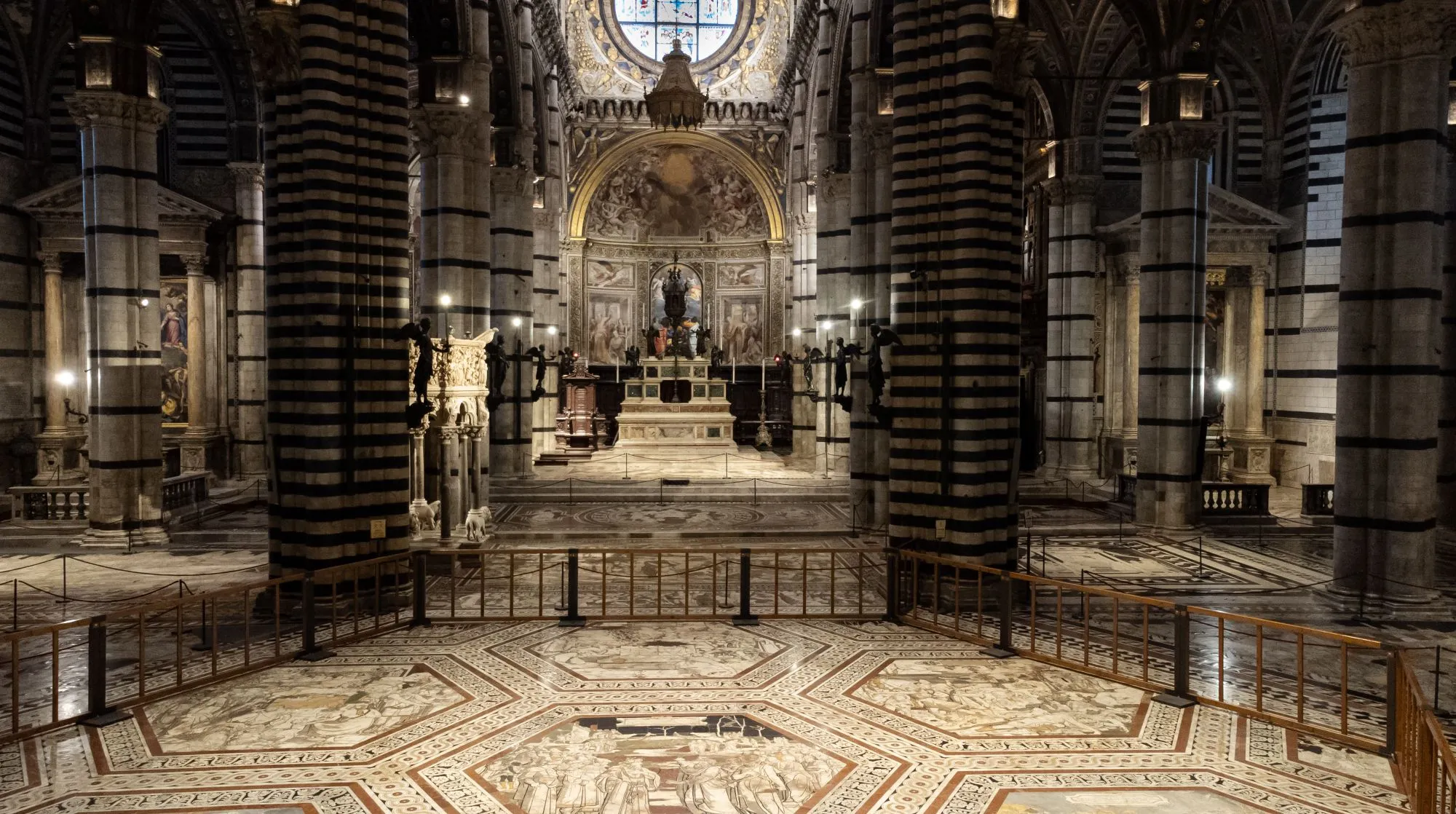
A commission that changed the history of art
On September 29, 1265, the Opera del Duomo di Siena entrusted Nicola Pisano with an extraordinary task: to create a pulpit worthy of the most ambitious Cathedral in Italy. Nicola was not alone: he was joined by his son Giovanni Pisano, the pupil Arnolfo di Cambio, future architect of Santa Maria del Fiore in Florence, and Lapo. Three years later, in 1268, the pulpit was completed.
What was born was not simply a liturgical artifact. It was a revolution.
A Bible carved in marble
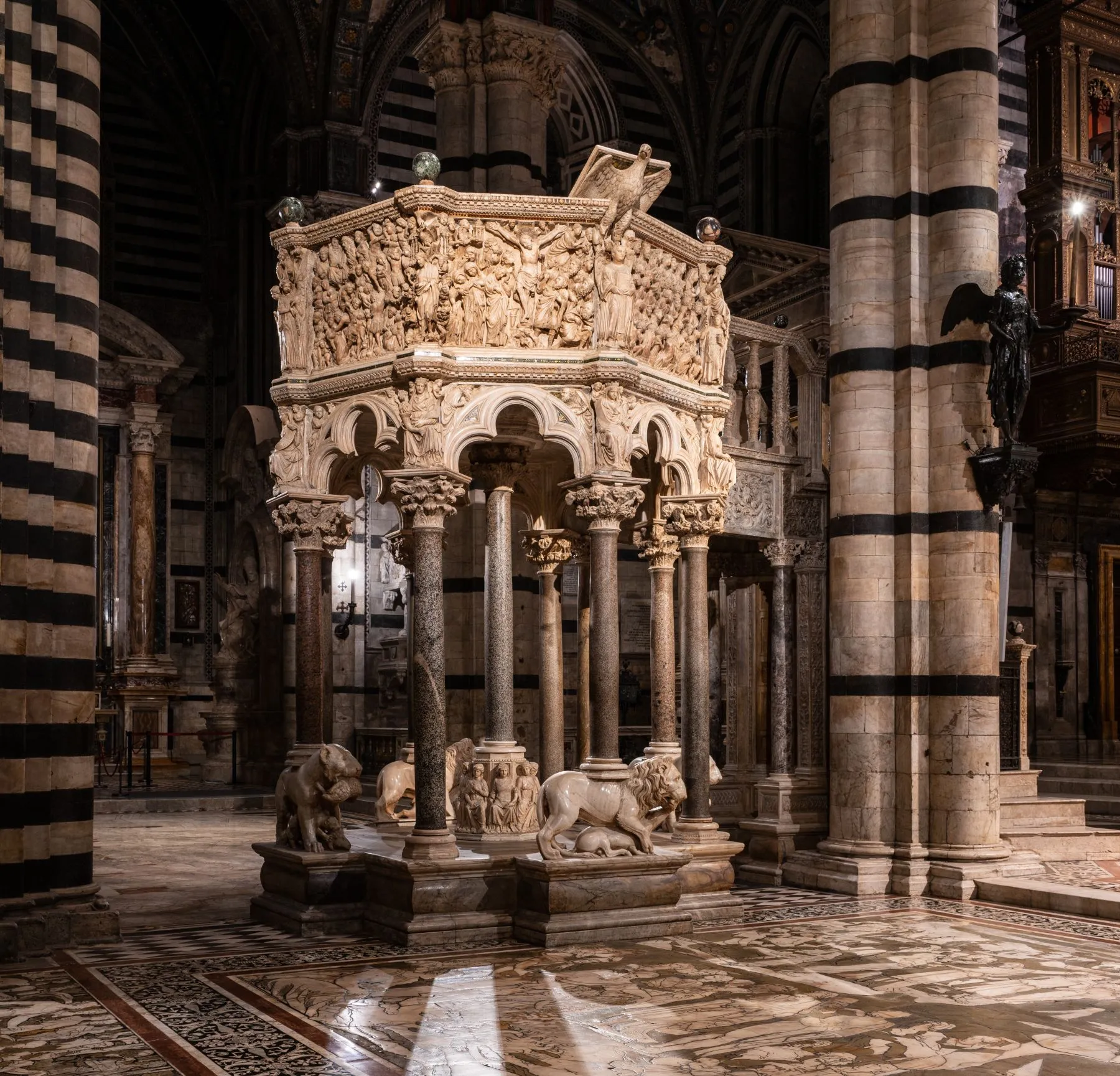
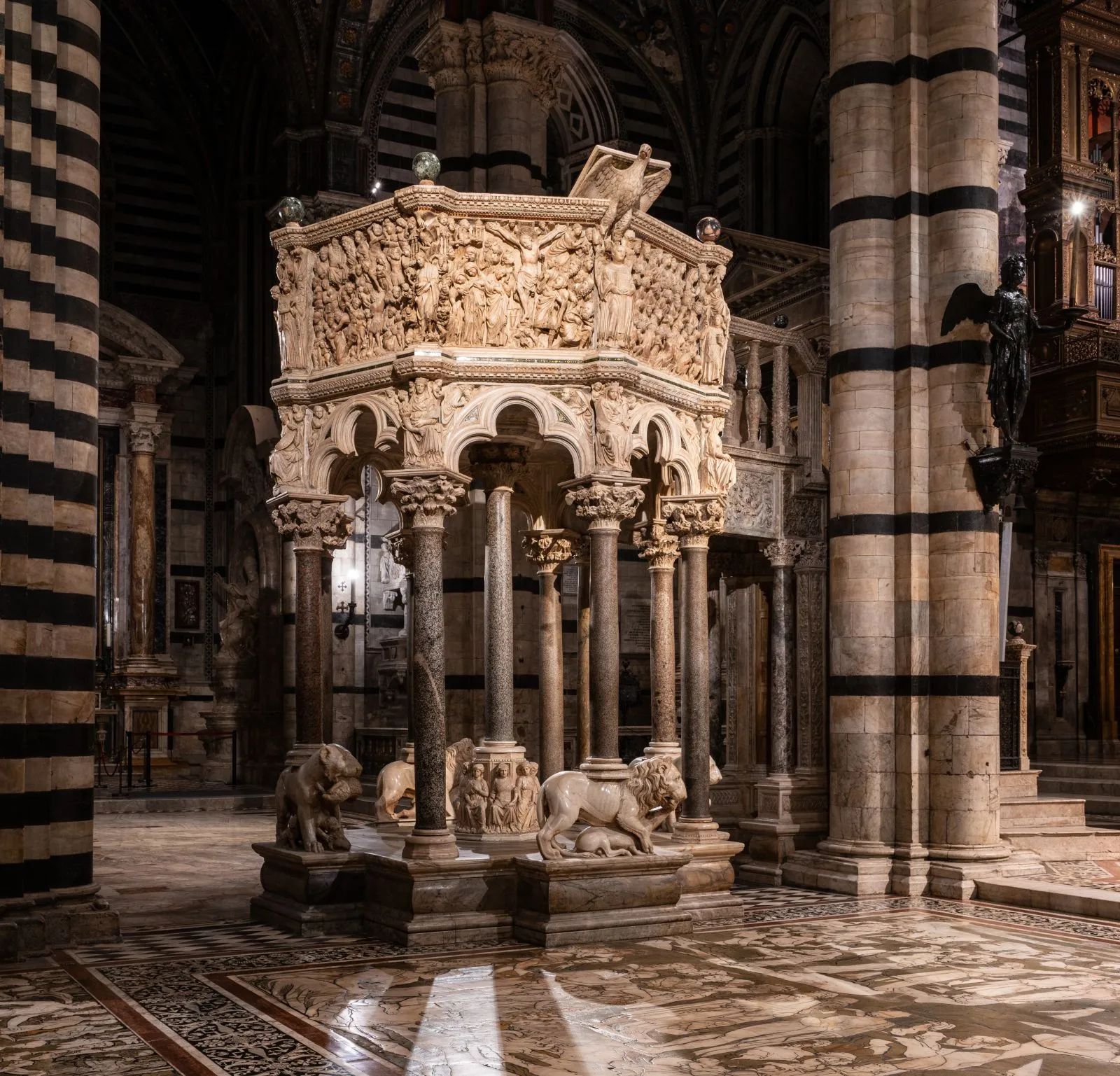
The pulpit has an octagonal shape, with marble columns supporting stylophore lions, symbols of strength, vigilance, and defense of the faith. Instead of small columns at the corners, there are full-round statues that give dynamism and life to the entire structure.
But the heart of the work is the narrative panels: a marble Bible designed to tell the story of salvation to all the faithful, including the illiterate. The depicted scenes, Visitation and Nativity, Adoration of the Magi, Massacre of the Innocents, Crucifixion, and Last Judgment, are populated by over 300 figures that interact with each other with a depth and humanity never seen before.
The most iconic reliefs
The Crucifixion and the Massacre of the Innocents
Among all the panels, two stand out with particular strength. The Crucifixion: Nicola Pisano brings here an emotional depth and a dynamism of the scene that anticipate decades of the great Gothic season. The Massacre of the Innocents: the drama of the mothers, the bodies, the pain represented without filters is something that still strikes and moves today. Marble that weeps, in some way.
The Seven Liberal Arts
At the base of the sculpture are carved the Seven Liberal Arts, Grammar, Rhetoric, Dialectic, Arithmetic, Geometry, Music, and Astronomy, along with Philosophy. A precise message: human knowledge is not in contrast with faith, but can help man to approach God.
The rediscovered colors and the Renaissance shift
Today the pulpit appears all white, but it has not always been this way. During the restoration completed in 2018, which removed centuries of dust and soot from votive candles, traces of original colors and gilding resurfaced: a work that originally was meant to be even more sumptuous and surprising.
The pulpit is now located in the left nave of the Cathedral, but it was originally positioned under the dome. In the 1500s it was moved and a Renaissance staircase was added, probably designed by Baldassarre Peruzzi.
Come see it
Entering the Cathedral of Siena and stopping in front of the Pulpit of Nicola Pisano means standing before one of the founding moments of Italian sculpture.
Cathedral of Santa Maria Assunta, Piazza del Duomo, Siena.