Pellegrinaio Hall, where art, history, and hospitality meet
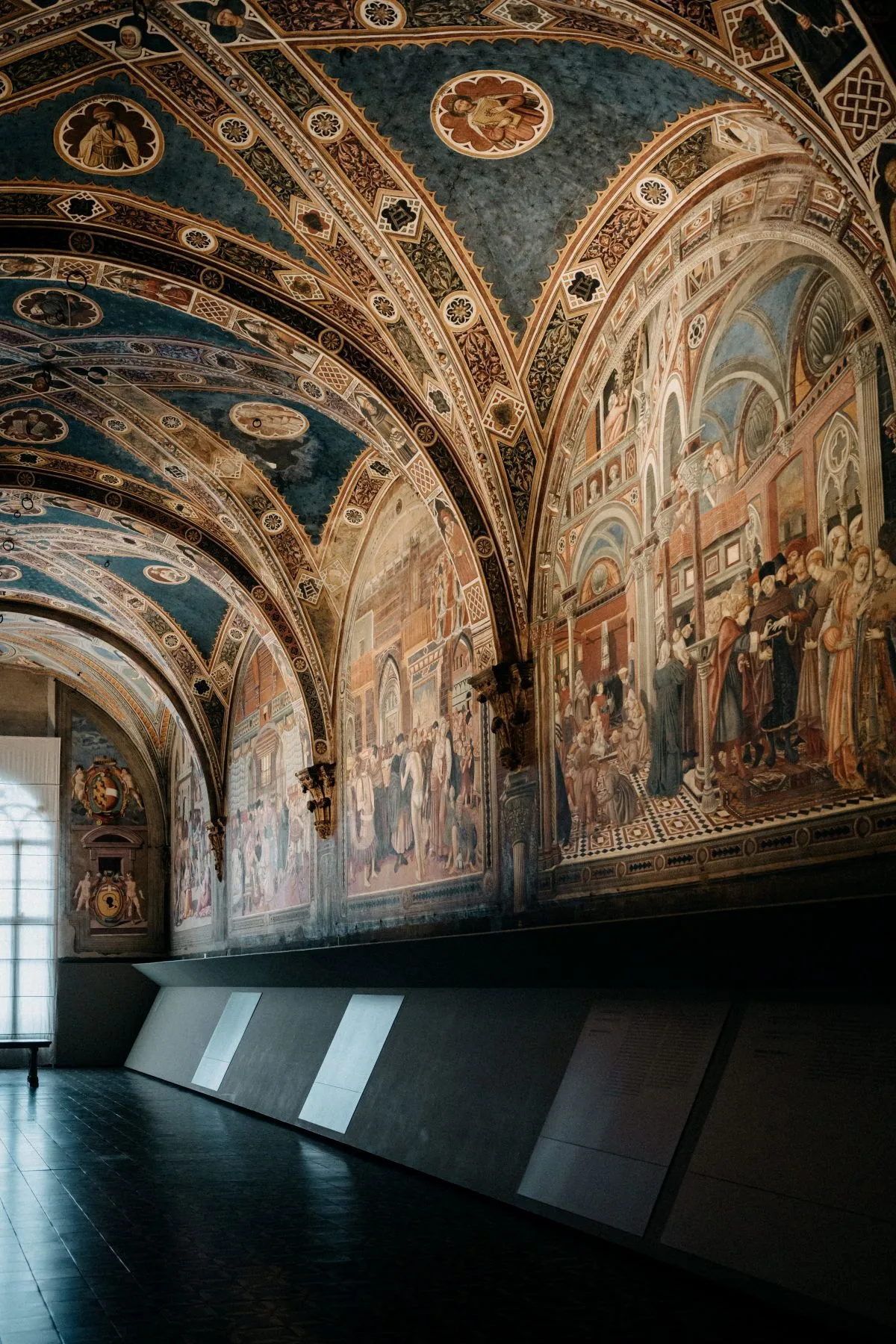
In the heart of Siena, in front of the Cathedral, there is a hall that tells the story of care, long before it became an act of hospitality and solidarity. The Pellegrinaio Hall, within the Santa Maria della Scala Museum Complex, was created between 1320 and 1380 as a large hospital corridor intended to welcome pilgrims, the sick, the poor, and travelers.
The name Pellegrinaio comes from its original function: a spacious, bright, hospitable area where those traveling the Via Francigena could find rest and free assistance. A place born to respond to the concrete needs of people, within one of the oldest hospitals in Europe.
The frescoes that tell the story of medieval healthcare
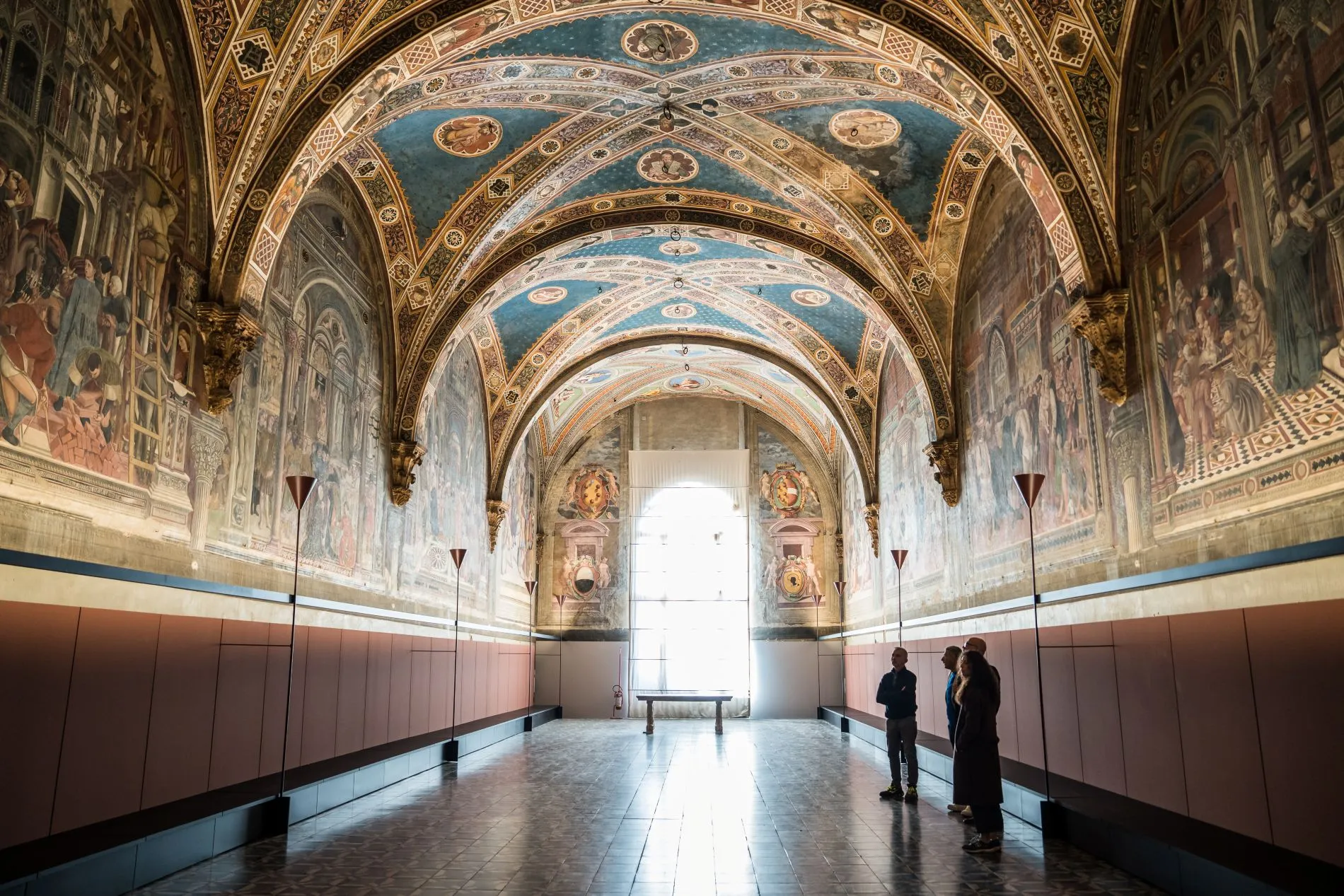
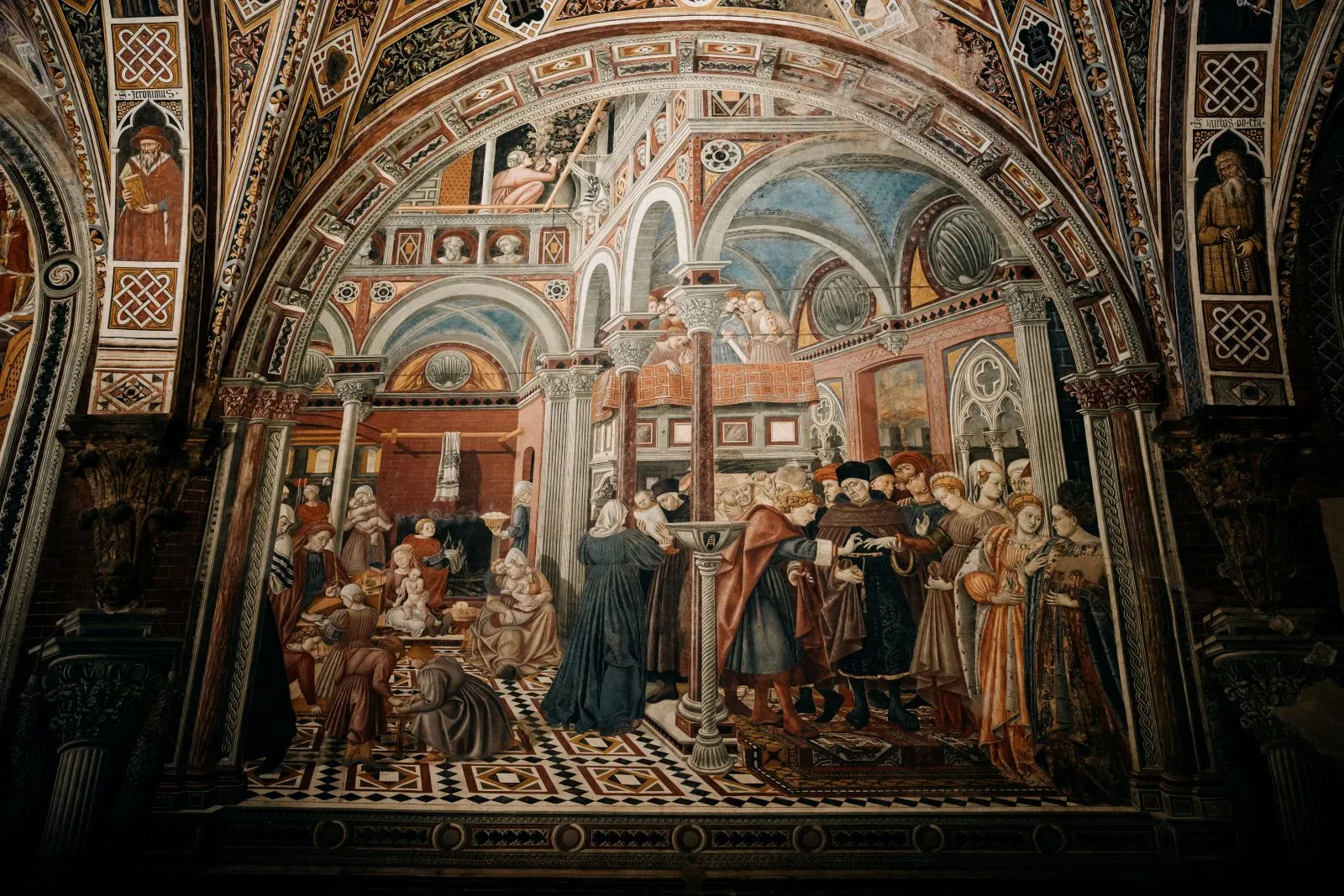
In the fifteenth century, the hall was decorated with a unique cycle of frescoes, created by important Sienese artists such as Domenico di Bartolo, Priamo della Quercia, and Lorenzo Vecchietta.
The scenes depict with surprising realism the daily life of the hospital: the welcoming of pilgrims, the care of the sick, the distribution of food to the poor, and the management of gettatelli, the abandoned children. Medical instruments, clothing, furnishings, and care practices are represented with great precision, offering a rare visual testimony of the forefront of medieval healthcare.
Pellegrinaio Hall: a solemn environment, designed as a narrative
The Pellegrinaio Hall still preserves its original architecture today: a spacious and majestic area, with wooden truss roofing and natural light that enhances the frescoes.
The pictorial cycle is designed as a continuous narrative, to be read from left to right. Each scene illustrates the charitable mission of the hospital and the role that Santa Maria della Scala had in Sienese society.
Santa Maria della Scala, a hospital for centuries
The Santa Maria della Scala remained active as a hospital until 1998, a fact that further strengthens the historical value of the hall. Here, the memory of assistance is not abstract: it is read in the walls, in the frescoes, in the very function of the space.
Even the construction of the male Pellegrinaio, in 1328, tells the importance of the project: to realize it, surrounding buildings were demolished and a significant height difference was overcome, with a remarkable engineering intervention for the time.
Visiting Pellegrinaio Hall today
Today, the Pellegrinaio Hall in Siena is one of the most visited areas of the museum complex. It is a place where art, history, and medieval solidarity intertwine powerfully, restoring the most human face of Santa Maria della Scala.
Visit the Pellegrinaio Hall and discover one of the most exciting spaces in Siena: a place where the beauty of the frescoes tells centuries of care, hospitality, and memory.
Credits:
- Luca Deravignone
- Roberto Testi