A hidden enigma in marble
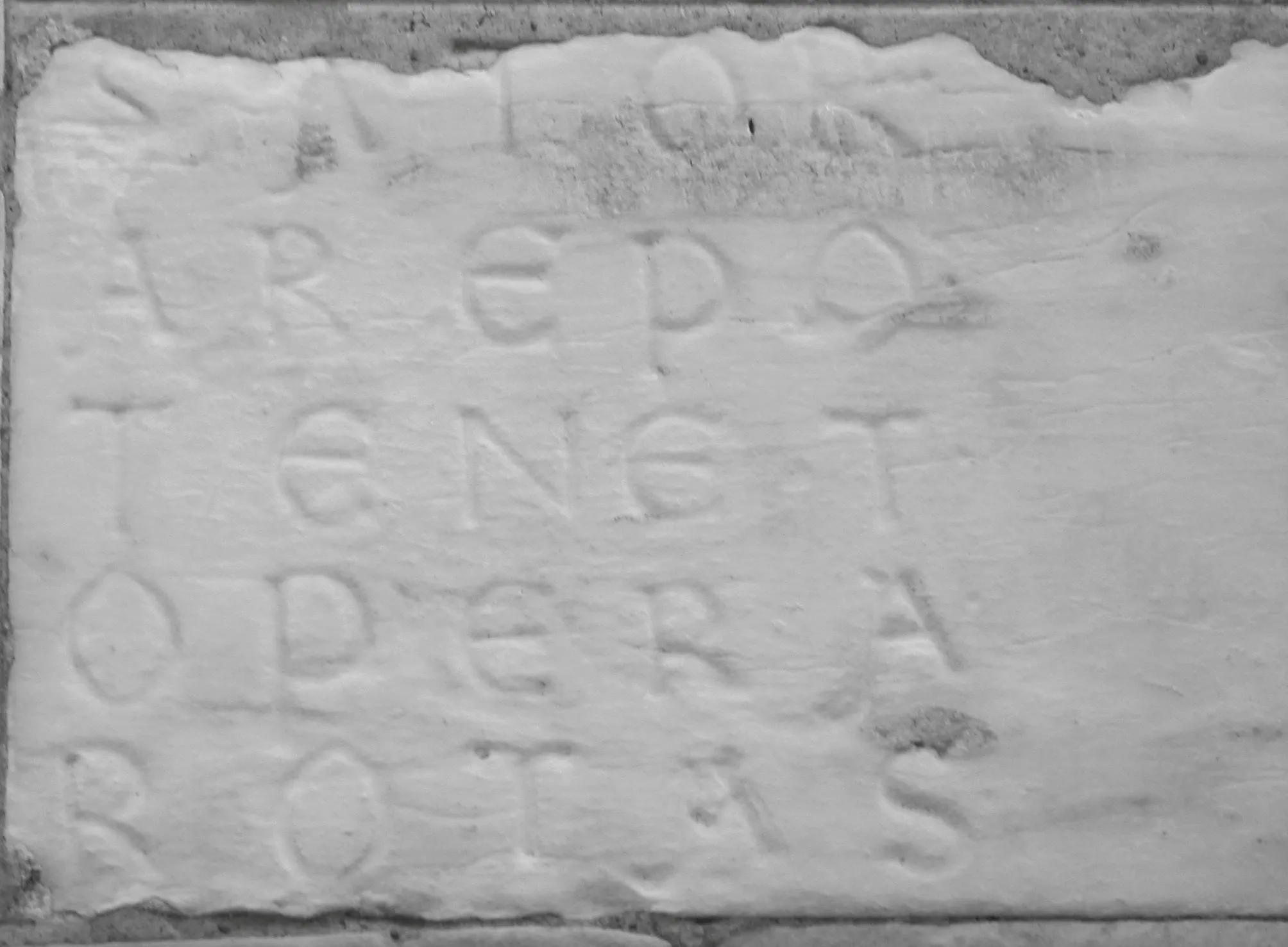
There is something strange on the outer wall of the Siena Cathedral, on the side facing the Archbishop's Palace. A small slab of light stone, set into the marble cladding of the cathedral, bears five words that have fascinated scholars, mystics, and simple curious minds for centuries. Five Latin words, twenty-five letters, arranged in a perfect square. It is the SATOR square: one of the oldest and most widespread epigraphic enigmas in the Western world.
How it works
The five words are: SATOR, AREPO, TENET, OPERA, ROTAS. Arranged in a 5×5 letter square, they form an extraordinary palindromic text: it reads the same left to right, right to left, top to bottom, and bottom to top. In any direction you go, the sequence remains identical.
At the center of the square stands the word TENET, which forms a cross readable both vertically and horizontally. In medieval thought, this geometric perfection was not accidental: the symmetrical order was considered a reflection of divine order, a sign that something sacred was hidden among those letters.
What does it mean?
The literal interpretation
The most common translation suggests: SATOR as "sower" or "creator", TENET as "holds", OPERA as "works" or "labor", ROTAS as "wheels". The term AREPO remains of uncertain meaning, and perhaps it is this mysterious word that keeps the entire enigma alive.
The hidden Christian symbol
One of the most suggestive interpretations links the square to the early Christian communities. By rearranging the letters, the words PATER NOSTER are obtained, arranged in a cross, with two letters A and O remaining at the edges: Alpha and Omega, symbols of Christ present in the Apocalypse. A hidden message, visible only to those who knew how to seek it.
An enigma that transcends time
The SATOR square does not belong only to Siena. It can be found in Pompeii, the oldest testimony, predating the eruption of 79 AD, in medieval manuscripts, on Coptic papyri, on Ethiopian amulets, and on religious buildings throughout Europe. A sign that has traveled through cultures, centuries, and continents, changing meaning without losing its power of attraction.
Why it is inscribed on the Siena Cathedral remains an open mystery: perhaps a divine protection over the sacred building, perhaps an invitation to spiritual reflection, or perhaps simply an enigma that someone wanted to leave there, knowing it would remain unanswered.
Find it yourself
The next time you are in front of the Siena Cathedral, turn to the left side, towards the Archbishop's Palace, and look for it. It is small, discreet, almost shy compared to the grandeur of the cathedral.
Left outer wall of the Cathedral, side of the Archbishop's Palace, Siena.