A man, a voice, a square
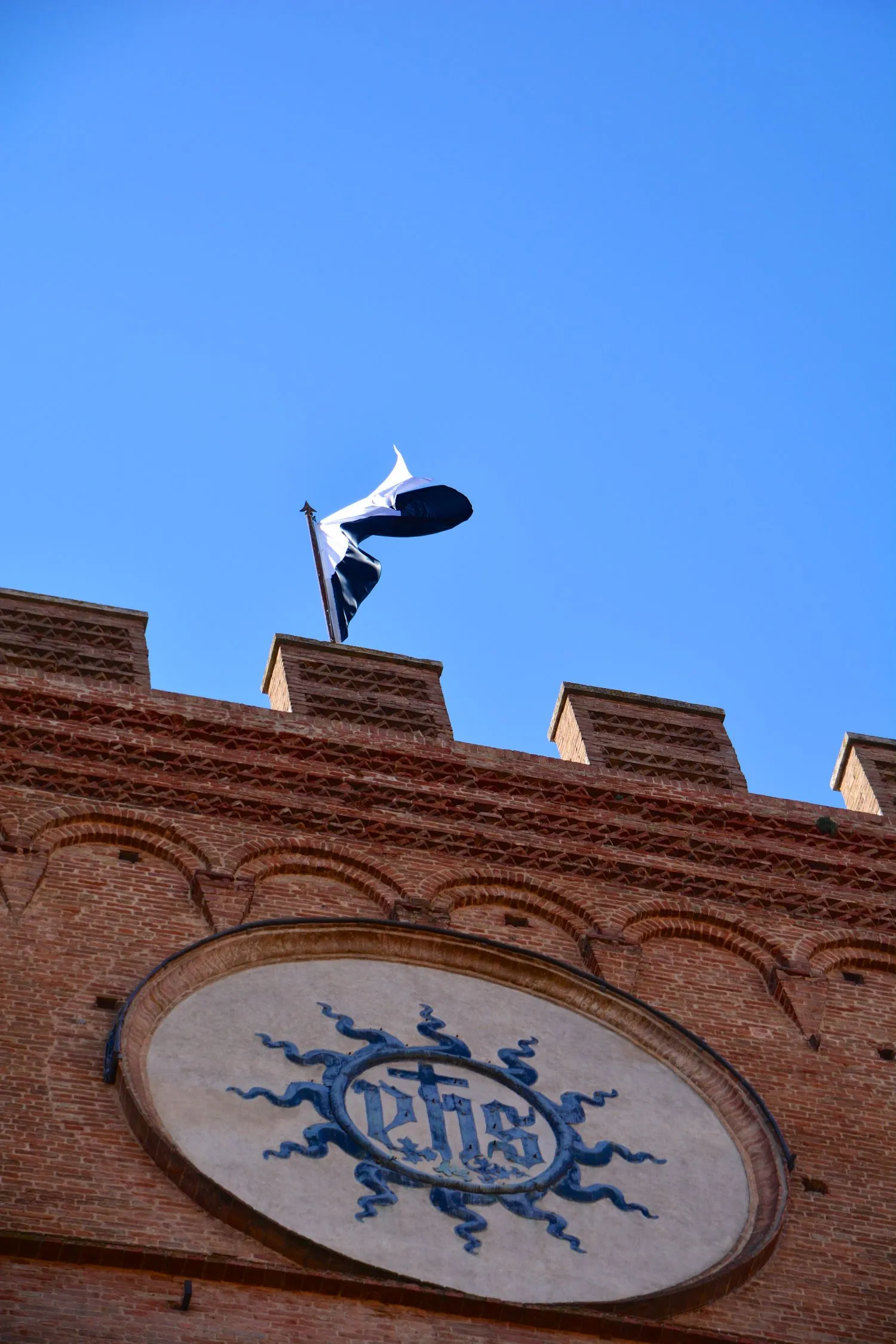
There is a symbol on the Palazzo Pubblico di Siena that many look at without knowing what it holds inside. It is the trigram of Saint Bernardino: a golden sun with the letters IHS at its center, shining on the facade like an ancient promise. To understand why it is there, one must know a man, and to know that man, one must imagine a square, Piazza del Campo, filled with thousands of people listening in silence to a single voice.
Bernardino da Siena was born in Massa Marittima, but it was Siena that shaped him, lost him, and found him again. Orphaned at an early age, he grew up in the city. When the plague of 1400 devastated Siena, he stayed: he assisted the sick, fell ill himself, and survived. And from that survival arose a vocation that would change all of Italy. In 1402, he joined the Order of Friars Minor, becoming a Franciscan. Then he began to preach.
The preacher of the squares
The churches were not enough. They were not large enough to contain all that Bernardino had to say, nor to hold the crowds that came to listen to him. So he chose the squares: open, democratic spaces accessible to all. He spoke in vulgar, using simple language, concrete examples, images that even the humblest commoner could understand and feel as their own.
He addressed the problems of his time with a frankness that astonished: the feuds between families, corruption, usury, public violence. He was not a preacher of consolation: he was a preacher of truth, and people followed him because they felt that truth truly concerned them.
The 45 days that Siena did not forget
The commemorative plaque
On the side of Piazza del Campo that faces the Palazzo Pubblico, a commemorative plaque remembers one of the most extraordinary events in Siena's history: starting from August 15, 1427, at the request of the Lords of the Municipality, Saint Bernardino preached to the Sienese for 45 consecutive days. For the occasion, an altar and a pulpit were built between the windows of the Town Hall: politics stepped aside to make room for the word.
That plaque is not just a memory. It is a witness to how those sermons changed the city.
The trigram, a sun of meanings
At the end of each sermon, the faithful approached to kiss tablets painted with the trigram: the monogram IHS, an acronym from Greek meaning "Jesus Savior of Men". Saint Bernardino took that ancient symbol and transformed it into something new: he enclosed it in a golden sun, creating an icon of devotion to the name of Jesus that spread throughout Italy.
The sun represents Christ, the 12 rays are the 12 apostles, the gold is divinity, the blue is humanity. A cosmos of meanings in a circle of light.
The trigram on the Palazzo Pubblico
Few years after those sermons, the Sienese goldsmith Tuccio di Sano and his son created the trigram that still today adorns the facade of the Palazzo Pubblico: an official act, a symbol of adherence by the Republic to the values of peace, harmony, and good governance that Bernardino had preached. Another trigram is also present on the Cathedral.
The Republic of Siena did not just listen: it chose to remember, to make that voice permanent, gluing it to the stone of its most important palace.
Where to find Saint Bernardino in Siena
The memory of Bernardino lives in various places in the city: the Oratory of Saint Bernardino in Piazza San Francesco, which houses the Diocesan Museum of Sacred Art, and the Basilica of Saint Bernardino dell'Osservanza, on the hill of Capriola just outside the walls, where his presence can still be felt in the air.