A narrow passage rich in history
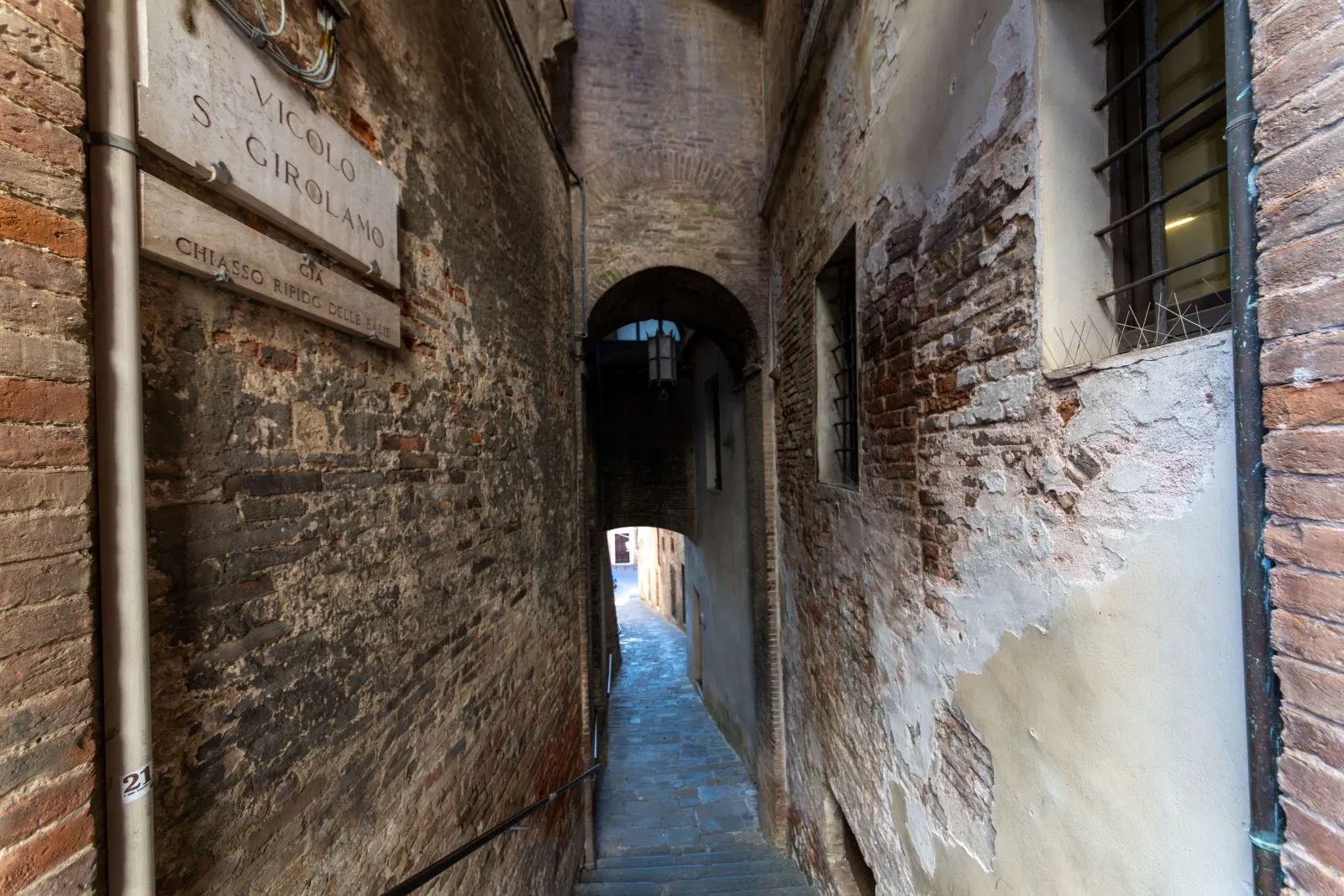
The alley connects via dei Fusari to the piazzetta della Selva, in the heart of the Terzo di Città. Its irregular shape follows the natural slope of the land and still preserves the ancient appearance, with close walls and characteristic glimpses that evoke the medieval atmosphere.
In the past it was known as Chiasso Ripido delle Balie, a name that directly recalls the presence of the Casa delle Balie of the Hospital of Santa Maria della Scala, where abandoned children, the so-called gittatelli, were raised. The alley was an integral part of the internal system of the hospital, serving as a link between religious and assistance environments.
In 1601, the Casa delle Balie was moved to this area, strengthening the alley's connection to the daily life of the hospital. Even today, architectural traces that recall this ancient organization are visible, such as bricked-up openings and internal passages that once connected the buildings.
The name and the Compagnia di San Girolamo
The current name, Vicolo di San Girolamo, dates back to 1871, when the function of the wet nurses ceased and the area changed its use. It derives from the Compagnia di San Girolamo and San Francesco, which was based along the alley, occupying spaces within the hospital buildings. These spaces were part of a complex building system, where religion, assistance, and services coexisted in a single urban corridor.
A place suspended in time
The presence of multiple functions in the same space is still readable in the structure of the alley, which retains a strong medieval character, with a narrow and continuous layout. Its position made it important for internal connections of the hospital complex rather than for public passage, making it today a quiet place, rarely visited, but authentic.
Walking through it, one can still perceive the original function: not a simple street, but a service urban corridor, a witness to daily movement, assistance, and the internal life of the city. It is one of the clearest examples of how Siena organized urban space in the medieval period in a functional and integrated way.